Every month, you invest in customer acquisition: advertising, cold emails, demos... But meanwhile, some of your customers are quietly leaving, and your profits are stagnating.
This is the issue of churn. By 2026, it will be possible to significantly reduce it by leveraging signals that your tools are already collecting, without a dedicated team or complex processes.
In this article, we present five practical strategies for reducing customer churn in the long term, with examples tailored to small and medium-sized French SaaS companies.
Strategy 1 — Eliminate early churn right from onboarding
The first 30 days: the critical window
According to UserGuiding, 90% of users who don’t understand the value of a product within their first week end up churning. In other words: if your customer doesn’t see the practical value of your product within the first few days, they’ll leave.
It’s not about missing features. It’s about time-to-value. The faster your customer achieves their first tangible result with your product (their “aha moment”), the more likely they are to stick around.
Activation failure signals to monitor in real time
To spot onboarding issues before it’s too late, identify your key activation metrics (those that correlate with 90-day retention) and track them starting on Day 3:
- First login: Did they open the product within 48 hours?
- Feature core used: Has the user performed your product’s main action at least once?
- Day 7 Follow-Up: Did he return a week after signing up?
If any of these milestones is not met, an alert is triggered that requires immediate action: a personalized email, a phone call, or targeted support.
Anti-churn onboarding without a dedicated team
Don’t have a Customer Success Manager? That’s not a problem if you automate the process effectively. Effective onboarding for a SaaS company targeting small and medium-sized businesses rests on three pillars:
- An automated email sequence based on behavior (not on the amount of time elapsed). If the customer hasn’t used feature X, they receive an email about feature X, not a generic email on day 5.
- A brief follow-up call on day 14 for high-potential accounts. Fifteen minutes is all it takes to identify any roadblocks and build a connection.
- Gradual disclosure: don’t give everything away at once. Guide them toward the value, step by step.
Strategy 2 — Build a system to detect early signs of churn
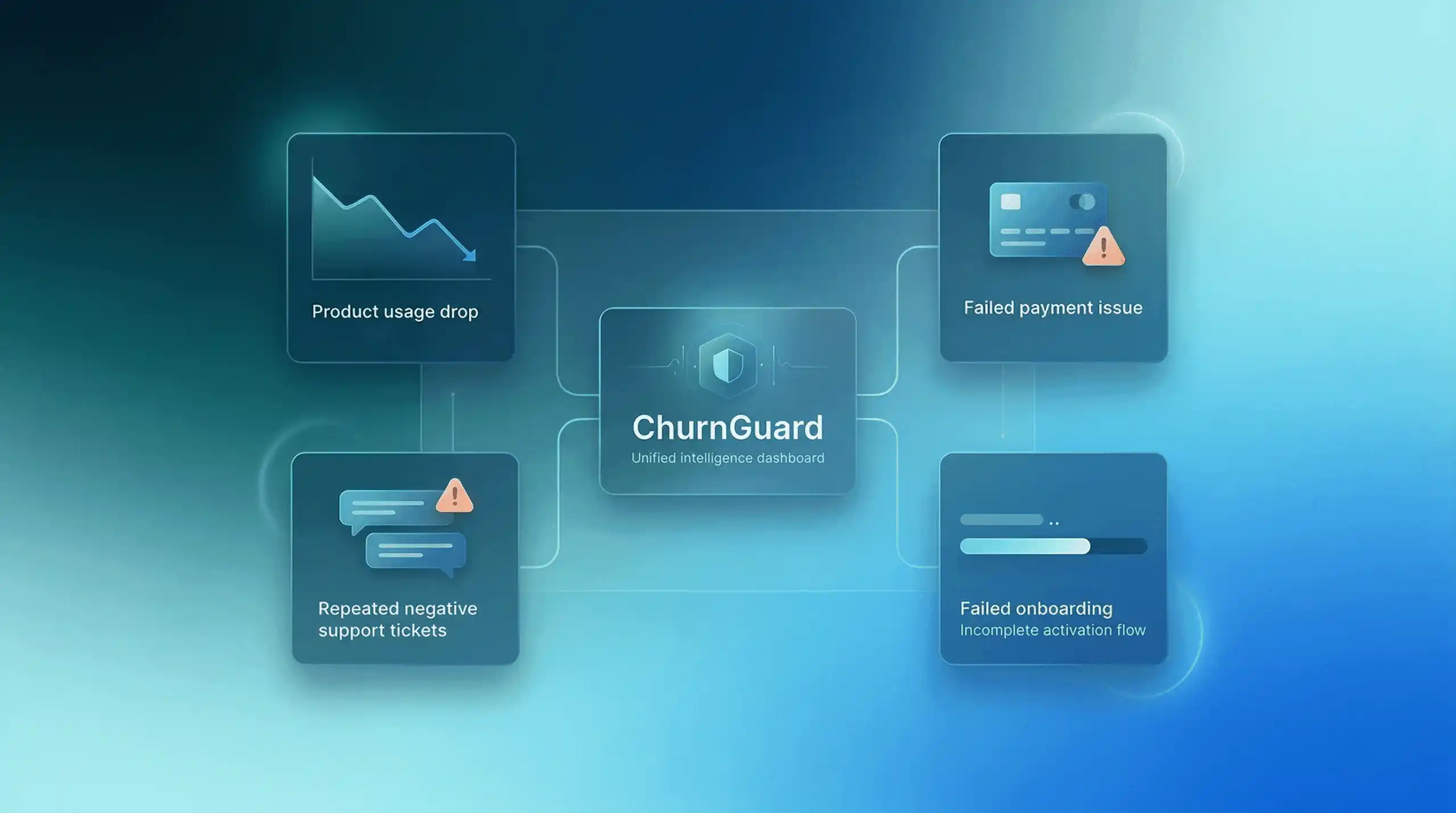
The 3 data sources to cross-reference to reduce churn: product usage, payments, and support
A single signal doesn’t tell us much. What accurately predicts churn is the combination of signals from different sources:
- Product usage: login frequency, features used, time spent in the app, key actions taken.
- Payments: failed attempts, downgrades, payment delays, plan changes.
- Support: number of open tickets, resolution time, unresolved tickets, sentiment detected in interactions.
Taken individually, each of these indicators can be explained by a thousand different reasons. When analyzed together, they form a reliable risk profile.
Why a single signal means nothing—and what their combination reveals
Here’s a concrete example: a customer who hasn’t opened your app in 10 days might just be on vacation. But that same customer, who also opened a support ticket 8 days ago without receiving a response and whose last payment failed, has a very high probability of churning within the next two weeks. It’s the combination of these factors that makes the difference.
From manual to automatic: How to switch to real-time detection
With 20 clients, you can track these metrics manually in a spreadsheet. With 50 clients, it’s already difficult. With 100 clients or more, it’s impossible without a dedicated tool.
The solution to reducing your churn: connect your data sources (payment tools, product tracking, support) to a system that automatically cross-references these signals and alerts you at the right time—with a recommended action based on the detected risk profile.
That’s exactly what ChurnGuard does: by connecting your payment tool, your product database, and your support system, ChurnGuard identifies at-risk customers in real time and suggests what to do—without you having to juggle three different tools.
Real-world example: What Stripe, product data, and support can tell you when combined
Here’s how this data integration works in practice using the signal × action matrix:
| Signal detected | Probable cause | Recommended action |
| No activity for more than 14 days | Disengagement / lack of perceived value | Personalized email + customer service call + offer of a re-onboarding session |
| Stripe payment failed | Unintentional churn / financial difficulties | Automated dunning process + human intervention if the second payment fails |
| 3 or more unresolved support tickets | Product friction / Blocking bug | Priority escalation + compensation offer |
| Inactivity + open ticket + payment issue | Critical combination = imminent churn | Immediate red alert + sales response |
| Sudden shift to the lower level | Budget constraints or dissatisfaction | Retention Notice + Proposed Rate Adjustment |
Strategy 3 — Recover from unintentional churn before it becomes too costly
Invisible churn: when your customers leave without meaning to
Between 20% and 40% of your churn isn’t due to customer dissatisfaction. It stems from a failed payment, an expired card, a blocked transfer, and a lack of follow-up in the hours that follow. A failed payment that isn’t addressed within 72 hours is four times less likely to be recovered than one addressed within half a day.
To help you respond quickly, we’ve prepared five ready-to-use email templates for failed payments, tailored to different types of SaaS customers.
Dunning management in 2026: The strategies that really work
Dunning management refers to the set of processes implemented to collect overdue payments. An effective dunning sequence in 2026 looks like this:
- Day 0 (payment failure): Automatic email notification to the customer (friendly tone, direct link to update payment method).
- Day 2: Second automatic payment attempt + follow-up email if payment is still outstanding.
- Day 4: Internal alert to your team (follow up personally if the account is high-value).
- Day 7: Final automatic attempt + a last-resort email offering a payment plan if necessary.
What’s changing in 2026 compared to past practices: the tone. Effective payment reminder emails are no longer cold, formal invoices. They’re personalized, empathetic, and focused on helping customers—not on collecting payments. If you want to reduce customer churn, you need to think about your customers before you think about their money.
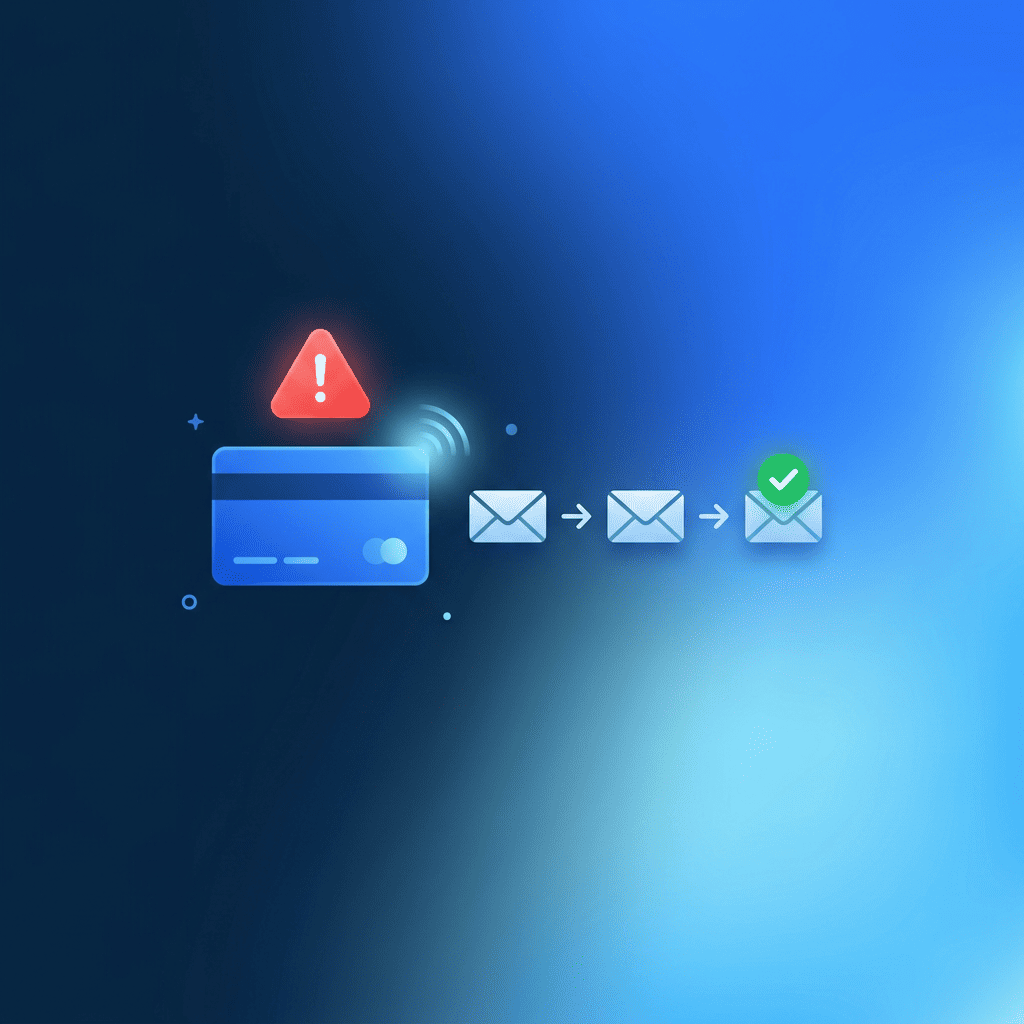
Automate debt collection without damaging the customer relationship
The pitfall of automated dunning: overburdening a customer who is already frustrated. Here are a few guidelines to follow:
- Never send more than 3 automated emails before a human representative intervenes for accounts with high MRR.
- Tailor the message based on the customer’s history: a customer who has been loyal for 18 months deserves to be treated differently than a new customer.
- Include a one-click link to update payment information; friction is the enemy of recovery.
Strategy 4 — Tailor actions to the cause of churn to reduce it
Why a single solution to churn is the wrong approach
Most SaaS companies have only one response to detected churn: sending a generic retention email or picking up the phone. It’s better than nothing, but it’s far from ideal. A customer who churns because they no longer use the product doesn’t need the same approach as a customer who churns because of a budget issue.
The key is to align the recommended action with the identified cause. This is only possible if you have cross-referenced the indicators (Strategy 3) to understand why this customer is at risk.
Examples of targeted actions based on the reason for churn
- Product disengagement → a personalized session to help you rediscover unused features, not a marketing email.
- Tight budget → proactively suggest a lower-tier plan or a subscription pause before cancellation.
- Unresolved support issue → priority escalation + goodwill gesture + personalized follow-up until resolution.
- Unintentional churn (payment) → a gentle dunning process + prompt personal contact for priority accounts.
- Competitor identified → exploratory meeting to understand what the competitor offers that you don’t.
How can I implement this logic without spending hours on it every week?
The challenge isn’t knowing what to do; it’s doing it at the right time, for the right customer, without spending your entire day on it. For a SaaS company without a dedicated CS team, the solution involves:
- Automated alerts triggered by the signal combinations identified in Strategy 3.
- Predefined action playbooks tailored to each risk profile, so you never have to start from scratch.
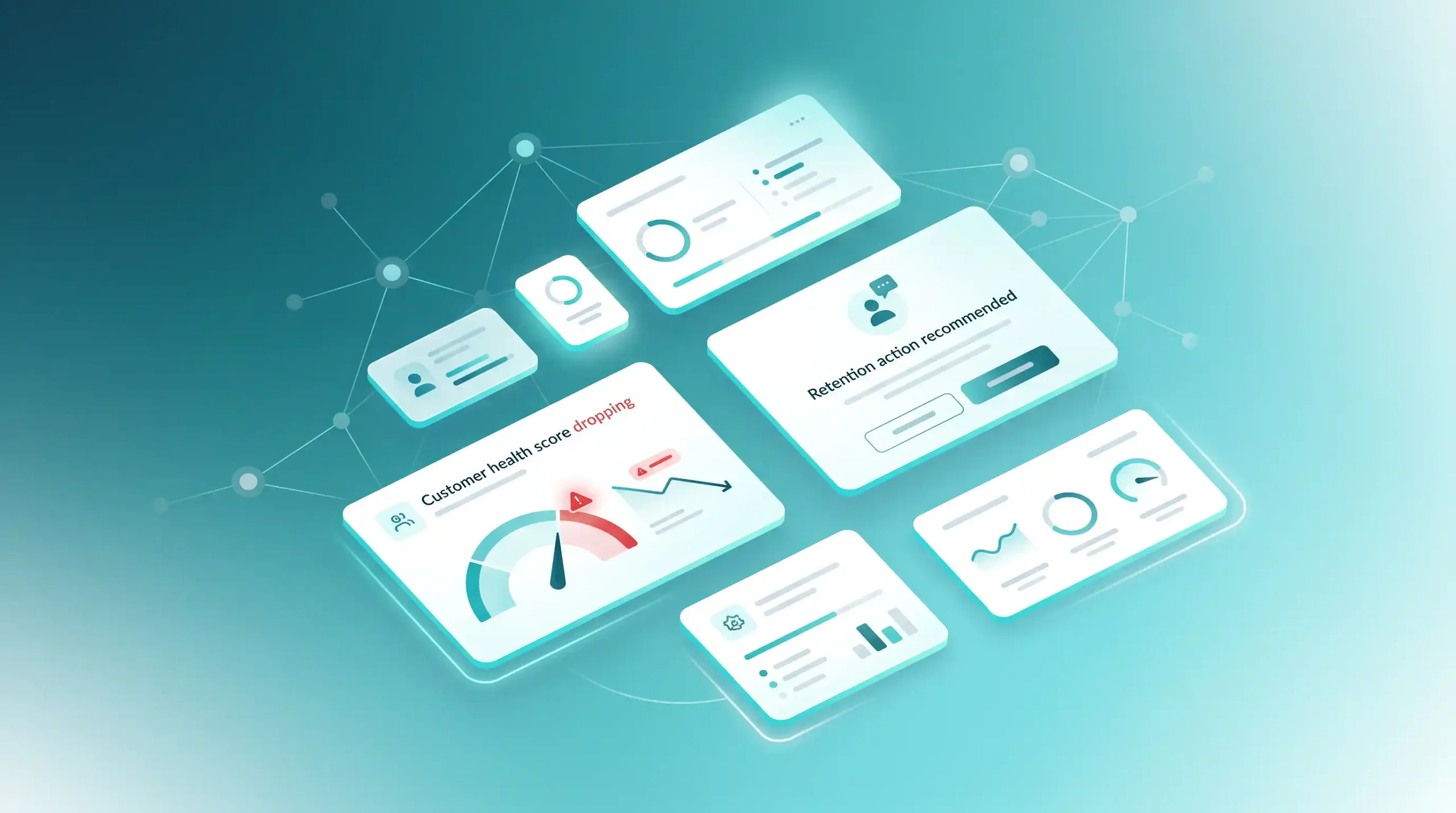
- A single dashboard that centralizes at-risk customers, their health scores, and recommended actions—without having to switch back and forth between Stripe, your database, and Zendesk.
Strategy 5 — Use customer feedback to boost retention
Where and how to collect feedback that indicates a risk of churn
Customers who are about to churn often send you signals through their feedback—provided you’re paying attention to the right places:
- During renewal interviews or periodic follow-up meetings.
- In support tickets: a recurring feature request is often a sign that the product does not yet meet the need.
- In cancellation forms—a must for any SaaS company looking to grow—the stated reason is valuable even if it is incomplete.
Closing the feedback loop: the step that no one takes
Collecting feedback without closing the loop is counterproductive. Closing the loop means: when you’ve rolled out a feature requested by a high-risk client, you let them know. Immediately. In person.
This moment creates a strong bond: the customer feels heard and valued, and often becomes an active advocate. It’s one of the few moments when reducing churn and generating positive word-of-mouth go hand in hand.
Before you try to reduce churn: Understand what your numbers are hiding
Logo churn, MRR churn, NRR: Which one should you focus on first?
Most SaaS founders track only one metric: the number of customers lost in a month. It’s a starting point, but it often masks the reality.
Let’s look at a concrete example. You lose 3 out of 100 customers this month, which amounts to a 3% customer churn rate. So far, so good. But if those 3 customers are your largest accounts, your MRR churn (the portion of revenue actually lost) could reach 15%. The same rate of customer loss, but a financial impact five times greater.
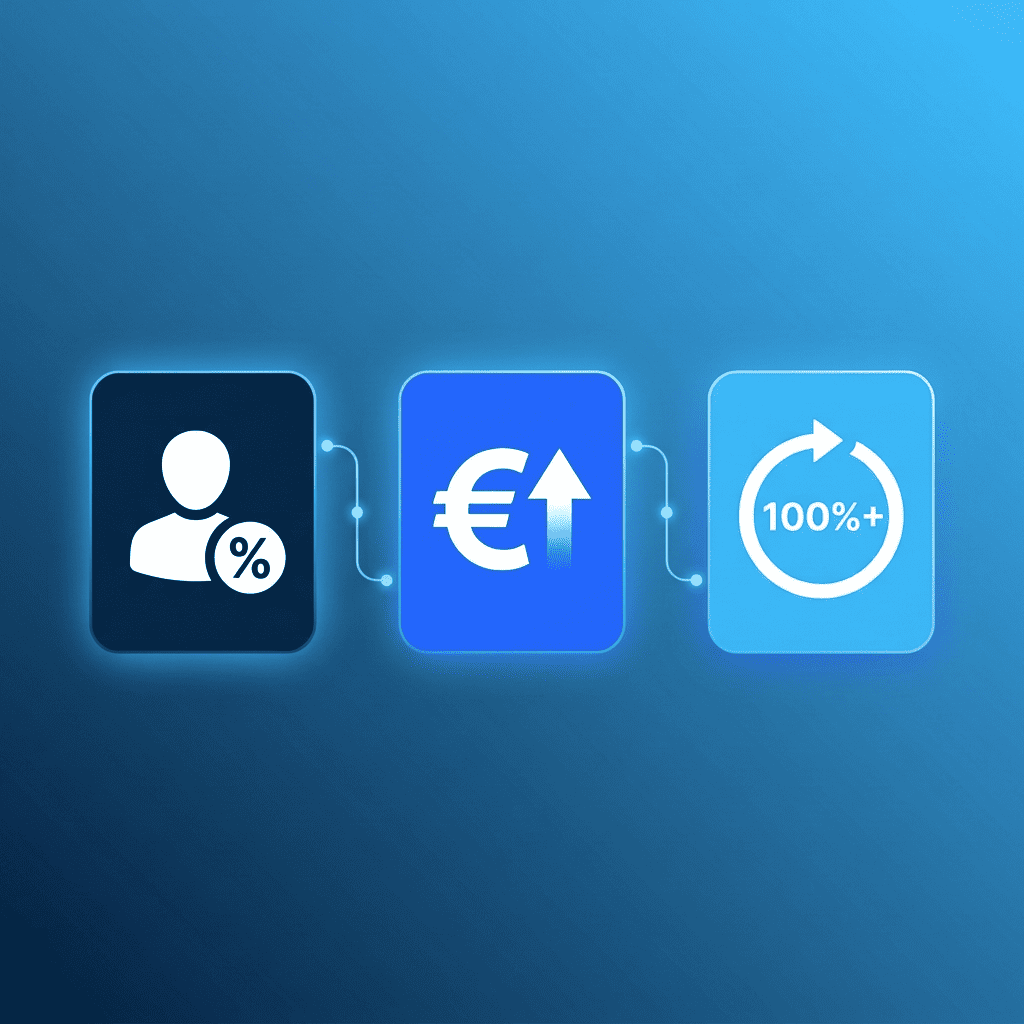
That is why these three indicators must be monitored together:
- Churn rate: the percentage of customers lost. This is the basic metric.
- MRR Churn: the percentage of monthly recurring revenue lost. This metric reflects the actual impact on your business.
- Net Revenue Retention (NRR): the most revealing of the three. It measures whether your existing customers are generating more or less revenue than at the start of the period, taking into account cancellations, downgrades, and upsells. An NRR above 100% means that your MRR is growing even without signing a single new customer—a sign of a structurally healthy SaaS business.
Here you will find details on how each indicator is calculated.
2026 benchmarks for SaaS companies: Where do you stand?
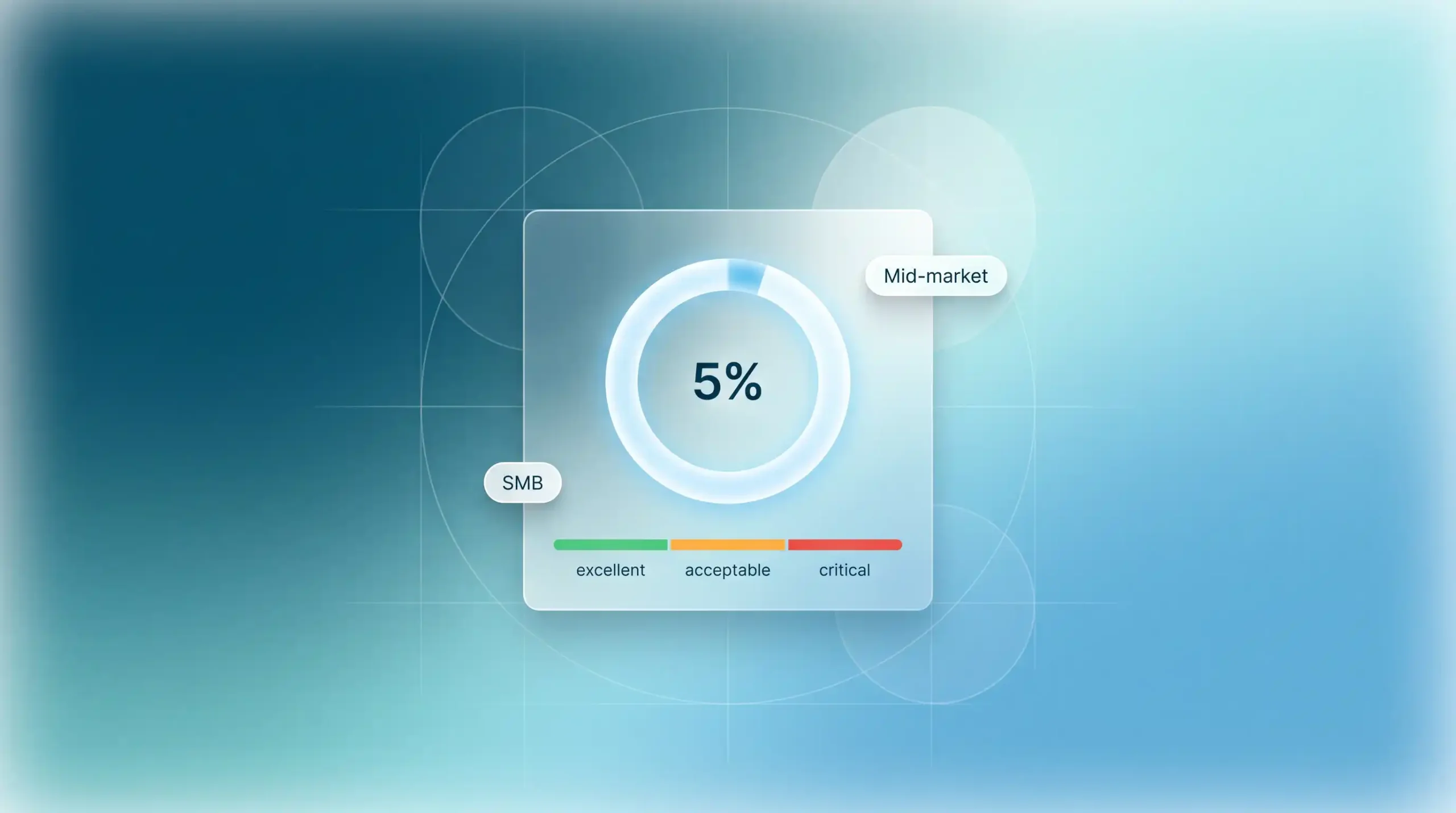
According to data from Chartmogul’s SaaS Growth Report, healthy B2B SaaS companies have a monthly churn rate of less than 2%. The best performers hover around 1.3% monthly. The higher your ARPA (average revenue per account), the lower your churn rate naturally tends to be: a customer paying $500/month is more engaged than one paying $29/month.
The silent impact of churn: A 24-month simulation
Let’s imagine a SaaS company with 100 customers, a monthly recurring revenue (MRR) of $20,000, and new business growth of 5% per month.
- With a 3% MRR churn rate, your 24-month MRR is unlikely to exceed $35,000.
- With an MRR churn rate of 1.5%, your 24-month MRR is approaching $52,000.
- The difference? Nearly $17,000 in monthly recurring revenue—that’s over $200,000 in lost annual revenue.
That’s why reducing churn (even slightly) is often more profitable than accelerating customer acquisition. If this topic interests you, check out our article on why retaining a customer costs five times less than acquiring a new one.
Conclusion
In 2026, early detection, swift action, and the right approach are no longer the exclusive domain of SaaS companies with dedicated Customer Success teams. The five strategies outlined in this article are here to prove it.
If you’re looking for a tool to put this framework into practice without spending hours on it every week, ChurnGuard was designed exactly for that: to connect your existing tools, cross-reference signals in real time, and tell you what to do before it’s too late.