You’ve acquired your first customers, built your product, and refined your pricing, and yet, every month, some of them leave without warning.
Churn, attrition, and cancellation: three terms for the same phenomenon that can quietly undermine your SaaS growth. According to a Bain & Company study published by the Harvard Business Review, reducing your attrition rate by just 5% can increase customer lifetime value by 25% to 95%.
In this article, a comprehensive guide to understanding, measuring, and combating churn in 2026.
1. Churn, attrition, unsubscription: what are we really talking about?
Churn rate: definition and origin of the term
The term “churn” comes from English and literally refers to the motion of “churning,” evoking the image of customers flowing in and out of a company’s customer base like milk in a churn. In the context of SaaS, the churn rate measures the percentage of customers or revenue lost over a given period.
This is one of the metrics most closely monitored by founders, investors, and product teams, as it directly reflects a SaaS company’s ability to retain the value it creates.
Attrition vs. churn: Is there a difference?
In French-speaking SaaS terminology, “attrition” and “churn” are often used interchangeably, and this is technically correct. “Attrition” is simply the preferred French term in formal or financial contexts to refer to the phenomenon of customer loss.
Some people distinguish between the attrition rate (the percentage of customers lost relative to the total) and absolute churn (the number of customers lost), but in practice, both terms refer to the same phenomenon: customers who do not renew their subscriptions.
Voluntary vs. involuntary unsubscription: two very different realities
It is crucial to distinguish between these two types of churn because they require radically different responses:
• Voluntary cancellation (active): The customer makes a conscious decision to leave (product dissatisfaction, high price, no longer needs the service, more attractive competitor).
• Involuntary cancellation (passive): The customer remains interested in theory, but their subscription ends for technical reasons (expired credit card, failed payment, billing error).
On average, involuntary churn accounts for 20% to 40% of a SaaS company’s total churn. With the right tools, this is often the easiest segment to win back.
Other terms to know: logo churn, revenue churn, net churn
In addition to the standard churn rate, there are several alternatives for measuring attrition more accurately:
• Logo churn: number of customers lost (each account = 1 logo), regardless of contract value.
• Revenue churn (MRR churn): value in euros/dollars of lost MRR. A customer paying $500/month who leaves counts for more than a customer paying $29/month.
• Net revenue churn: revenue churn after deducting expansion revenue (upgrades, upsells). It can be negative—this is the holy grail, a sign that your existing customer base is growing faster than it is shrinking.
2. How to calculate churn rate (and avoid mistakes)
The basic formula for the churn rate
The formula for calculating monthly churn seems simple at first glance:
| Churn rate = (Customers lost during the period / Customers at the start of the period) × 100 Example: 10 customers lost out of 200 at the start of the month = 5% monthly churn |
This formula seems simple, but it has its pitfalls. For example, should you include new customers acquired during the period in the denominator? The answer is no; doing so would artificially lower your churn rate.
Monthly churn vs. annual churn: how to switch between the two
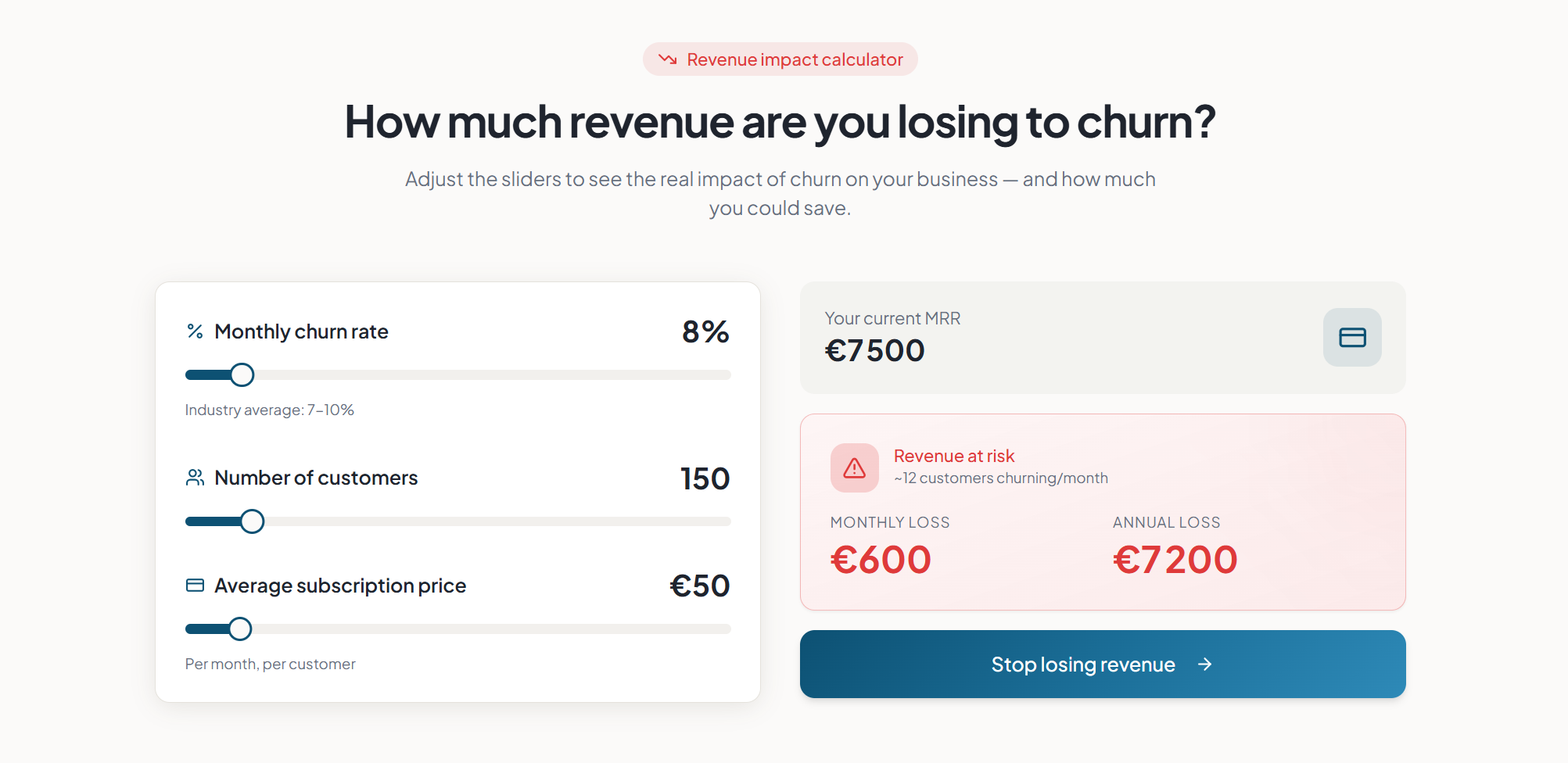
A monthly churn rate of 3% may seem reasonable. But on an annualized basis, it amounts to a loss of approximately 31% of the customer base over the course of a year, which is critical for the growth of a SaaS company.
The calculation works as follows: Annual churn = 1 – (1 – monthly churn)^12. A monthly churn rate of 5% therefore translates to an annual churn rate of 46%—which is nearly half your customer base!
Revenue churn (MRR churn): Why it’s more important than logo churn
The churn rate can be misleading. Losing 10 out of 200 customers looks the same in both of the following scenarios, but the financial reality is radically different:
• Scenario A: 10 customers at $29/month lost = -$290
MRR• Scenario B: 10 customers at $500/month lost = -$5,000 MRR
That’s why finance teams and investors consistently focus on MRR churn rather than logo churn. It provides an accurate picture of the actual impact on your growth.
Net revenue churn: when growth offsets losses
Net revenue churn includes expansion revenue to provide an even more accurate picture of the health of your customer base:
| Net churn = (MRR lost – MRR gained) / MRR at the start of the period × 100 A negative net churn means that your existing customer base is growing on its own |
Top-performing SaaS companies like HubSpot and Slack have long reported negative net revenue churn, meaning that even without new customers, their MRR continued to grow.
Common errors in calculating attrition
• Including new customers in the denominator (dilutes the actual rate)
• Confusing cancellations with downgrades (a customer who downgrades their plan is not a churn but contributes to revenue churn)
• Failing to distinguish between acquisition cohorts (attrition varies depending on customer maturity)
• Calculating churn over periods that are too short (high variability over 30 days; use 3-month averages instead)
3. What are the churn benchmarks for SaaS in 2026?
Benchmark by company size (SMB, mid-market, enterprise)
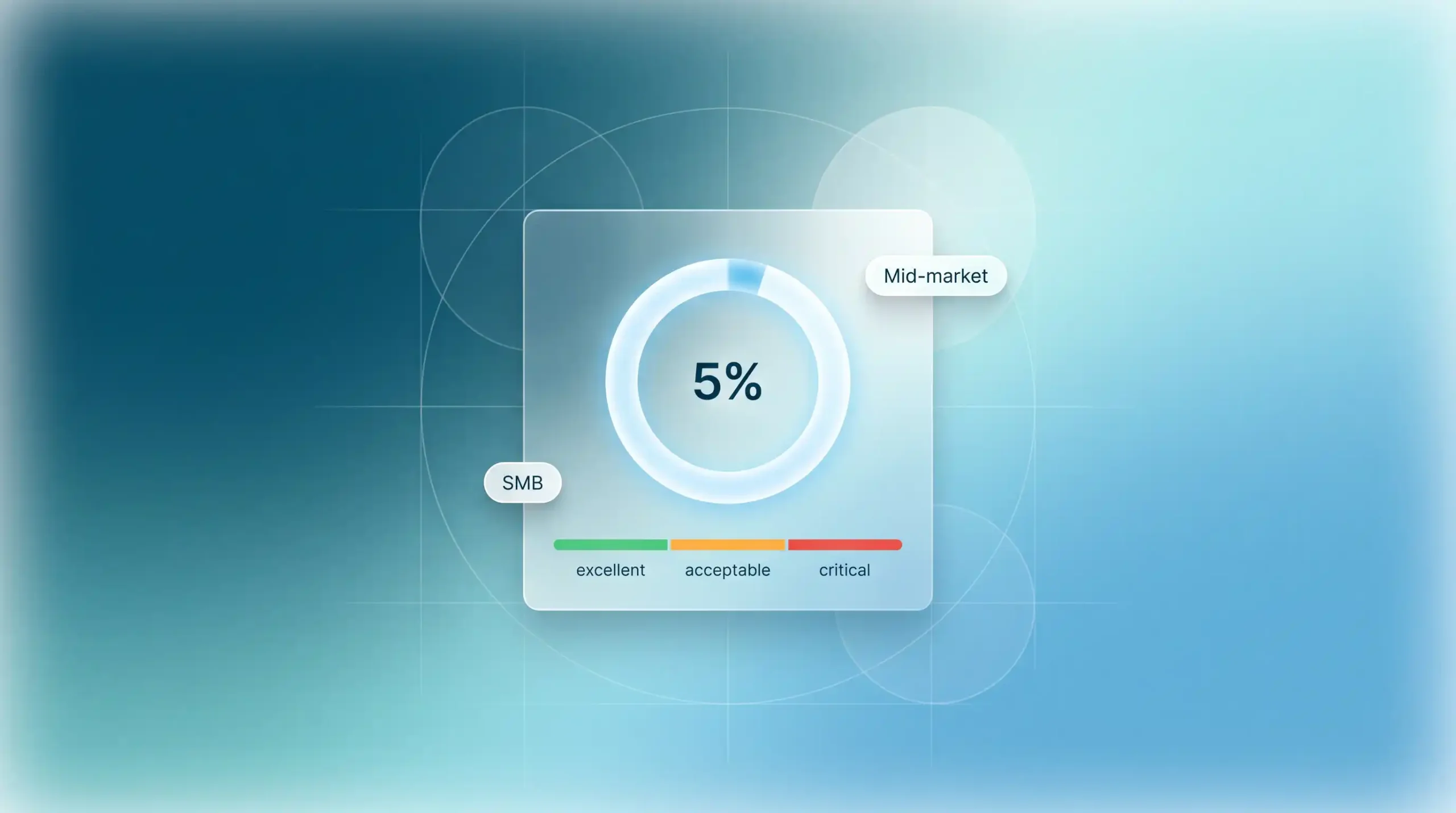
The acceptable churn rate varies significantly depending on the target customer segment. SaaS companies serving SMBs (small and medium-sized businesses) structurally experience higher churn because their customers are more volatile:
| Segment | Acceptable monthly churn | Annual churn rate |
| SMB (fewer than 50 employees) | 3–7% | 30–58% |
| Mid-market (50–500) | 1–3% | 11–31% |
| Enterprise (> 500) | 0.5–1.5% | 6–17% |
Benchmark by pricing model (monthly vs. annual)
The billing cycle has a direct impact on churn. Annual subscriptions automatically reduce churn by fostering longer-term commitment and limiting cancellation windows. On average, SaaS companies with a high proportion of annual subscriptions have churn rates that are two to three times lower than those of their monthly subscription counterparts.
Benchmark by industry
Not all SaaS markets are created equal. Highly competitive sectors or those addressing non-critical needs experience structurally higher churn:
| Sector | Average annual churn | Risk level |
| HR / Payroll | 4–8% | 🢐 Low |
| CRM / Sales | 8–15% | 🡡 Moderate |
| Marketing / Analytics | 15–25% | 🟠 High |
| Collaborative tools | 10–20% | 🡡 Moderate |
| Billing / Finance | 3–7% | 🢐 Low |
What the top SaaS companies say: the numbers to aim for
Fast-growing SaaS companies aim for a monthly churn rate of less than 2% for SMB customers and less than 1% in the mid-market. Cobloom’s industry study suggests that a monthly rate exceeding 5% is a serious red flag for SMB SaaS companies, as it translates to an annual rate exceeding 46%—a critical threshold regardless of the segment.
📊 Best Practices for SaaS: Aim for an annual logo churn rate below 10% and a net revenue churn rate that is negative or close to zero. If your annual churn rate exceeds 20%, this is a top priority that must be addressed before ramping up customer acquisition. |
4. Why do your customers churn? The real reasons
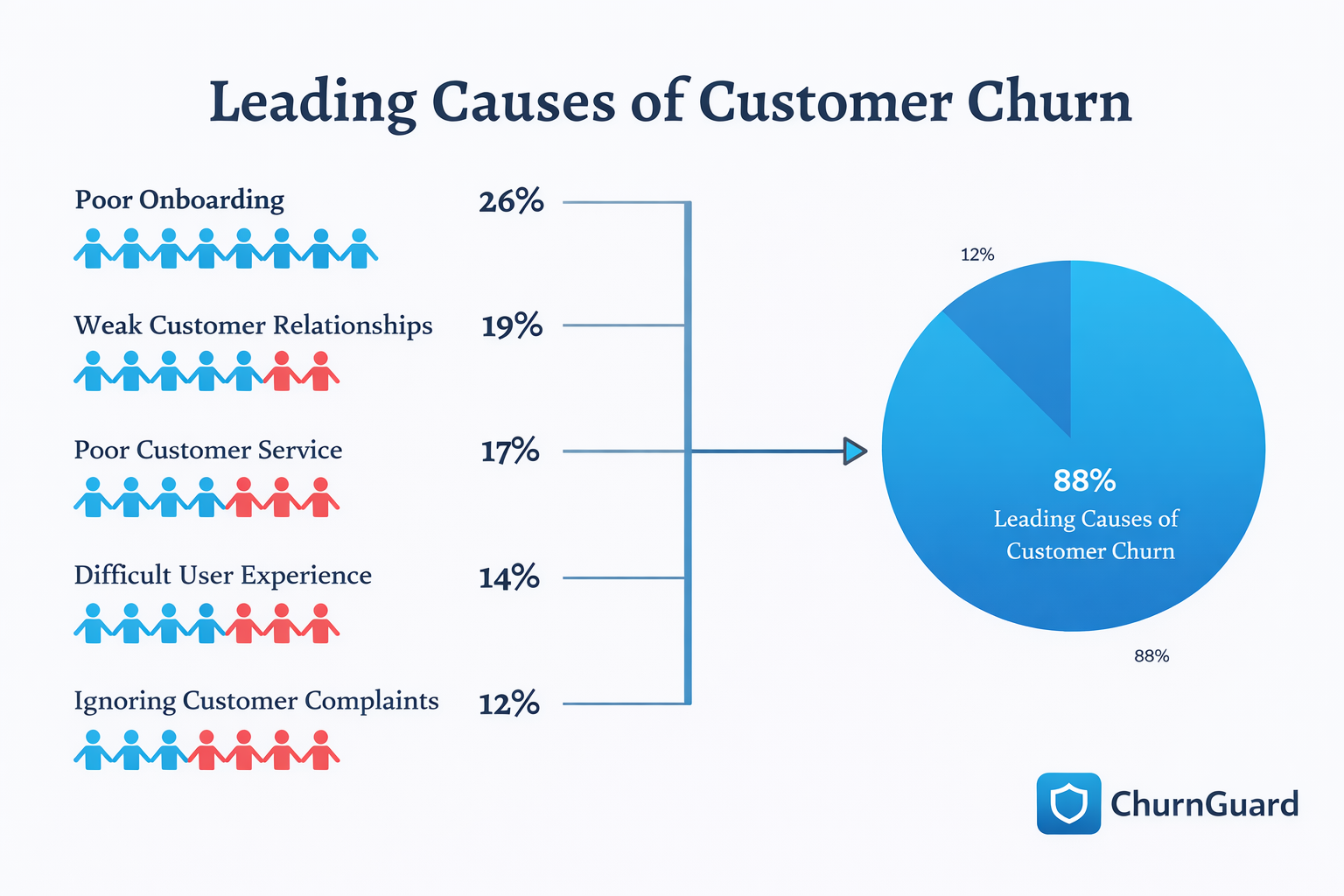
The lack of activation and onboarding
This is the leading cause of early churn (within the first 90 days). A customer who doesn’t quickly grasp the value of your product won’t renew their subscription, regardless of their initial intentions at the time of purchase. The “aha moment” must occur as early as possible in the customer journey.
Product non-adoption and inactivity
A customer who no longer uses your product is a customer on the verge of churning. A decline in login frequency, a decrease in the number of features used, or a reduction in the volume of actions taken are all behavioral warning signs that foreshadow churn, often several weeks before the customer actually cancels their subscription.
A poor product-market fit from the outset
Some churn is structural: it stems from a mismatch between the profile of the acquired customer and what your product is capable of addressing. An overly broad acquisition strategy that targets unsuitable segments always results in high churn. It’s better to acquire fewer customers but do so more effectively.
A price perceived as too high relative to the value
Cancellations due to price are rarely about the price itself; they’re almost always about perceived lack of value. If your customer doesn’t clearly see what you’re providing them each month, the ROI of their subscription will seem negative to them, regardless of the amount charged.
Competition and alternatives
A simpler, cheaper, or better-marketed competitor can lead to substitution churn. This is particularly true in mature markets where switching costs are low. The solution isn’t always a new product: sometimes, you simply aren’t communicating your unique value proposition effectively enough.
Support and customer experience issues
An unresolved support ticket, a delayed response, or a frustrating experience can lead to customers canceling their subscriptions. Studies show that a customer dissatisfied with support is four times more likely to cancel their subscription than a satisfied customer, even if the initial issue was minor.
Unintentional churn: failed payments and expired cards
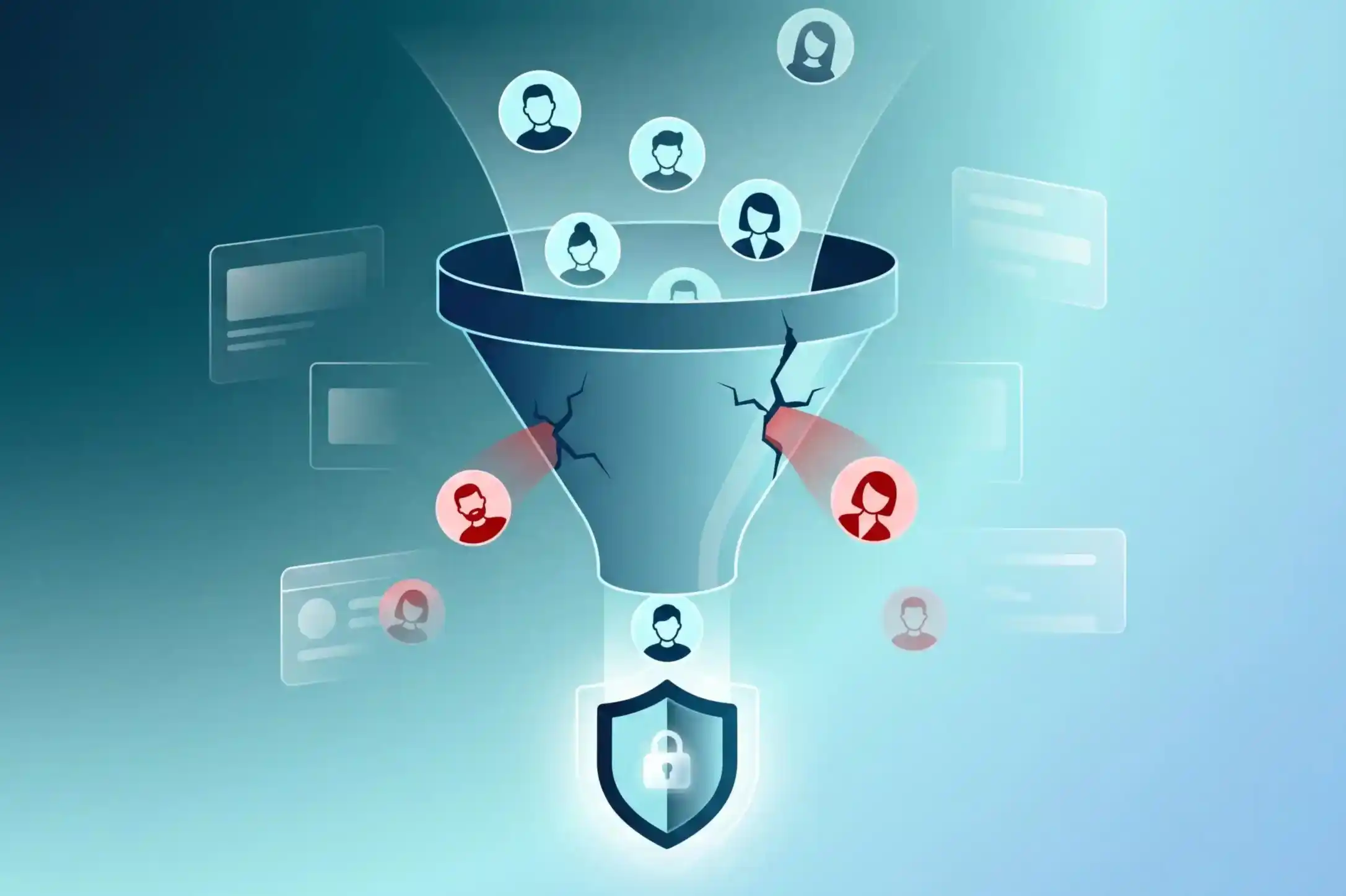
This type of cancellation is often overlooked, yet it accounts for a significant portion of total churn. Credit cards expire, spending limits are exceeded, and bank account information changes during corporate restructuring. Without a proactive follow-up system, these customers leave without ever having intended to do so.
To prevent customer churn before it’s too late, check out our 5 ready-to-use email templates for failed payments.
5. How to spot churn before it happens: warning signs
Behavioral indicators (decline in usage, disengagement)
Behavioral analysis is the most reliable way to predict churn. Key indicators to watch for include: a decrease in the number of weekly sessions, a reduction in the number of features used, the discontinuation of key features, and an increase in the time between logins.
A customer who used to use your product five times a week but has now cut back to once every two weeks is sending you a clear signal that they’re losing interest—long before they send you a cancellation email.
Billing alerts (downgrades, repeated payment failures)
A plan downgrade is often a gradual cancellation. A customer who switches from your $99/month plan to your free plan is testing the waters for a smooth exit. Repeated payment failures (even if recovered) are also a warning sign: they indicate that the relationship is starting to lose value in the customer’s eyes.
Support signals (recurring tickets, lack of response)
Analyzing support history is an underutilized goldmine. Negative indicators include a rise in unresolved tickets, messages expressing explicit frustration, or—more insidiously—a complete cessation of all contact with support (silence often precedes a customer’s departure).
Churn Risk Scoring: How to Implement It
The customer health score is a composite score that aggregates multiple indicators to produce a churn risk rating. It typically combines data on product usage (frequency, depth), billing (payment history, current tier), and support (NPS, open tickets).
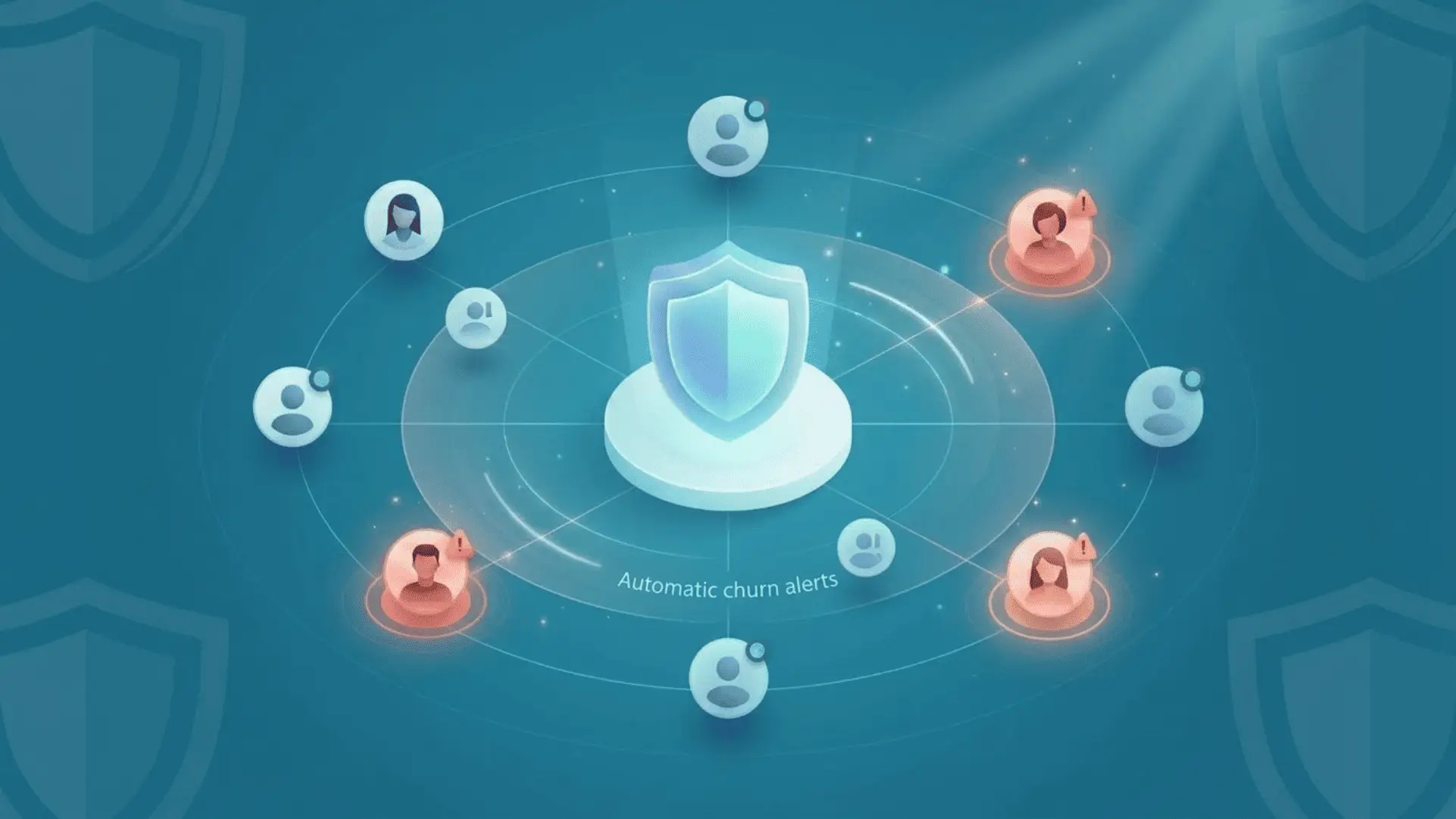
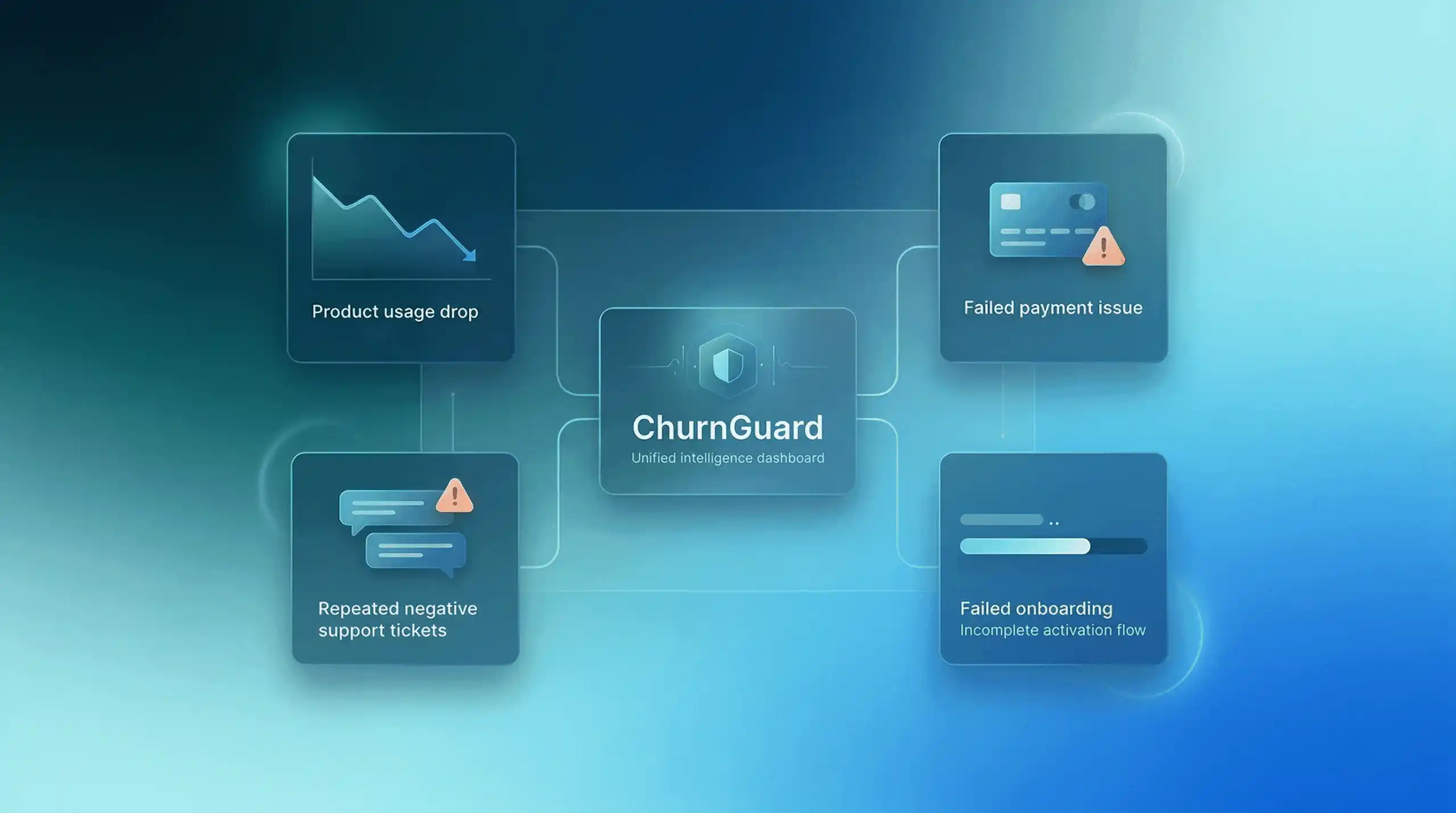
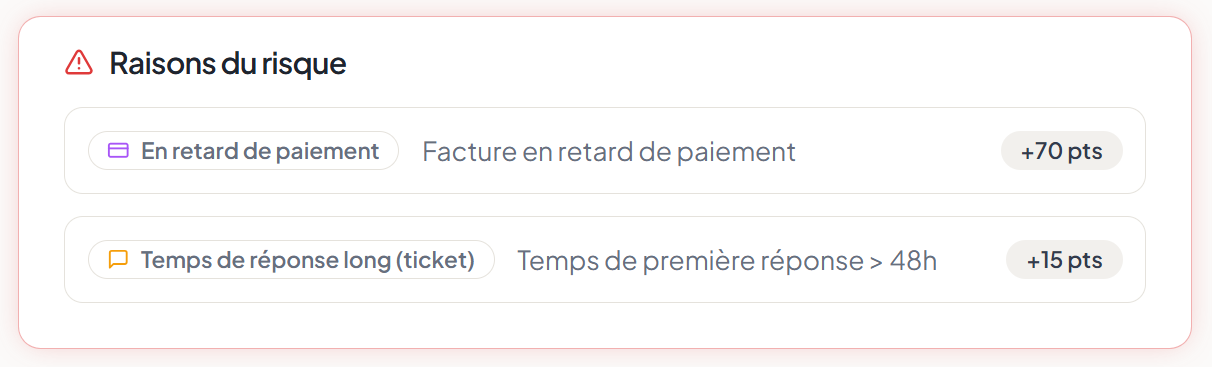
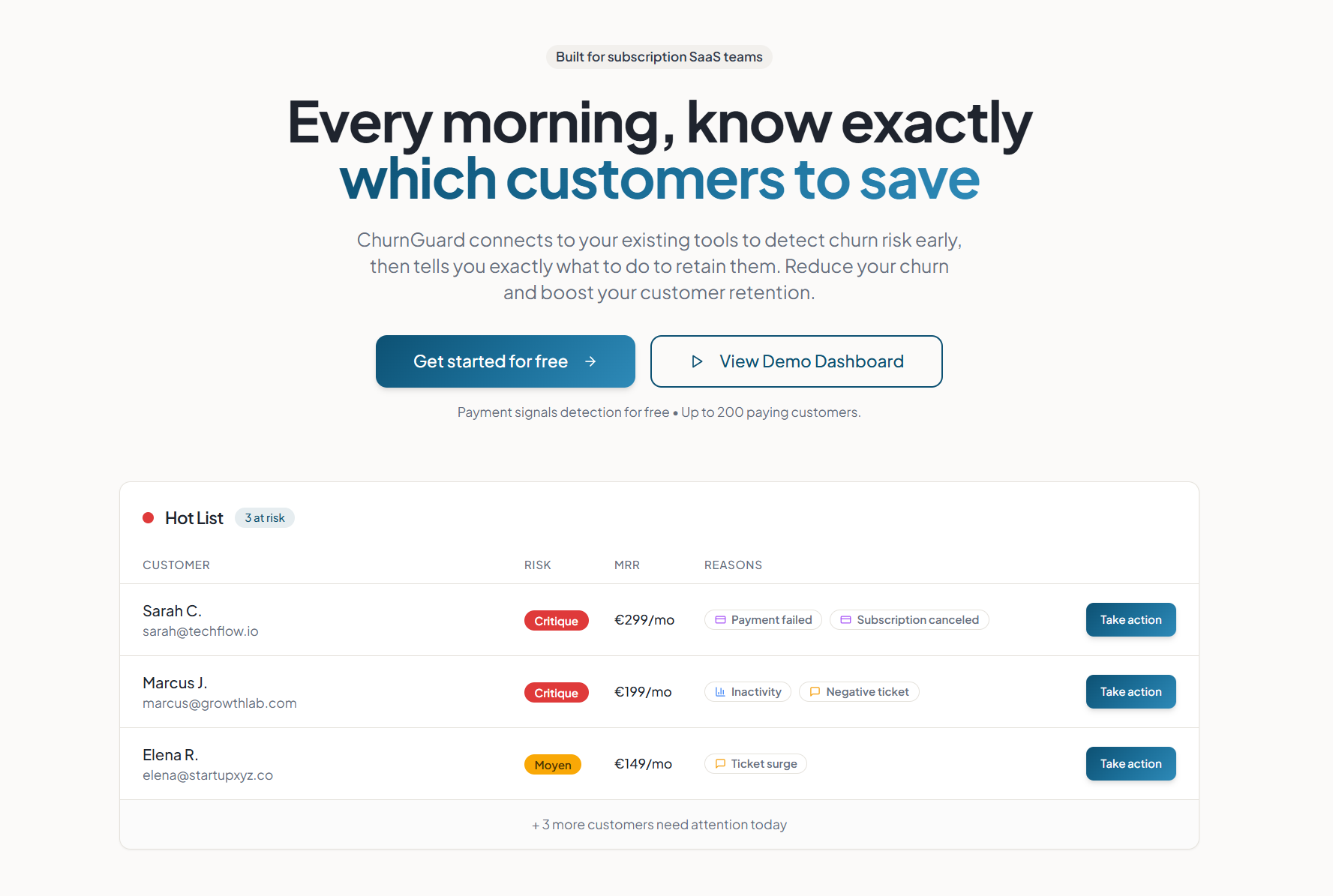
That’s exactly what ChurnGuard does instantly and continuously. As soon as a churn signal is detected for a customer (unpaid invoice, ticket left unanswered within 48 hours, decline in product activity, downgrade), ChurnGuard automatically assigns them a numerical risk score. These scores accumulate as signals are detected. This accumulation produces an overall risk level per customer, updated in real time, which allows your team to prioritize their efforts on the customers most at risk, without having to manually configure scoring rules or cross-reference data across multiple tools.
How far in advance can churn be detected?
On average, behavioral signals precede cancellation by 30 to 90 days for an SMB SaaS company. This timeframe determines your window of opportunity. The earlier you detect these signals, the more time you have to take action, and the higher your chances of retaining the customer.
6. Strategies for reducing churn in 2026
Improve onboarding to reduce early churn
Onboarding is your first—and often only—chance to establish a usage habit. Effective onboarding should guide the customer to their “aha moment” within seven days. Activation checklists, sequenced welcome emails, onboarding webinars, personalized demos: every action that accelerates the creation of perceived value automatically reduces your early churn.
Launch targeted re-engagement campaigns
When a customer starts to disengage, a well-designed re-engagement campaign can turn the tide. Its effectiveness depends on personalization: the message should reference what the customer used to use, show them what they’re missing, and offer concrete help. A generic “We miss you” email is counterproductive.
Offer a demotion rather than let them go
When dealing with a customer who is considering canceling due to budget constraints, the best option isn’t always to fight to keep the contract at its current level. Offering a downgrade to a lower-tier plan allows you to preserve the relationship, maintain a foothold in the market, and create an opportunity for a future upgrade. Keeping a customer at $29/month is better than losing a customer at $99/month.
Addressing involuntary churn with smart payment reminders
Unintentional churn can be addressed through smart automation: automated email follow-ups before and after a payment failure, simplified updates to payment methods, and a grace period before account suspension. Tools like Stripe include dunning management features that can recover up to 30% of failed payments.
Building a feedback loop with at-risk clients
When a customer churns despite your best efforts, turn that loss into a learning opportunity. A brief exit survey (3 questions max) about why they left will help you identify recurring patterns and prioritize your product and sales initiatives accordingly.
Timing and responsiveness: Why every hour counts when dealing with a churn signal
The time between detecting a churn signal and taking action is one of the most critical factors in customer retention. A customer who has begun to disengage can still be retained—but that window closes quickly.
This is exactly the challenge that ChurnGuard addresses. As soon as a churn signal appears (decrease in usage, failed payment, frustration ticket), ChurnGuard detects it immediately and generates a context-specific recommendation: what message to send, through which channel, and with what value proposition. The goal is to turn every signal into a retention opportunity, at the right time and with the right pitch.
| ⚡ The advantage of timing SaaS companies that take action within 24 hours of a signal appearing are, on average, three times more likely to retain the customer than those that wait until the following week. Detection alone isn’t enough: it’s the speed of coordinated action that makes the difference. |
For more information on each of these strategies, check out our comprehensive guide to reducing churn in 2026.
7. Churn and SaaS metrics: How it all fits together
Churn and LTV (Lifetime Value): The Fundamental Equation
Lifetime Value is directly determined by your churn rate. The basic formula is: LTV = average MRR / monthly churn rate. A monthly churn rate of 5% results in an average customer lifetime of 20 months. Reducing this rate to 2.5% automatically doubles the LTV, without affecting your pricing or customer acquisition.
If this topic interests you, we explain here why retaining a customer costs 5 to 25 times less than acquiring a new one.
Churn and Customer Acquisition Cost (CAC): Why Reducing Churn Improves Your Profitability
The LTV/CAC ratio is a key indicator of a SaaS company’s health. If your CAC is $500 and your LTV is $1,500, your ratio is 3 (acceptable but room for improvement). Cutting your churn rate in half increases your LTV to $3,000 and your ratio to 6, without spending a single additional euro on acquisition. Retention is one of the most underutilized drivers of profitability.
Churn and NPS: The Link Between Satisfaction and Retention
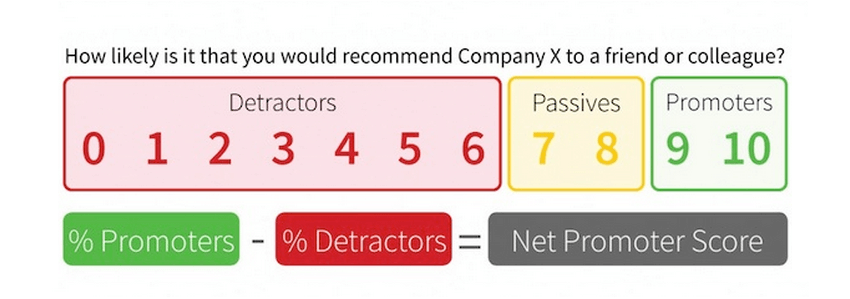
The Net Promoter Score is a leading indicator of future churn. Promoters (NPS ≥ 9) churn on average 5 to 10 times less frequently than detractors (NPS ≤ 6). Regularly measuring the NPS and correlating it with usage behavior makes it possible to identify at-risk segments even before behavioral signals become apparent.
Churn and Revenue Growth: The Best Way to Counteract Churn
The ultimate strategy against churn isn’t just about retention; it’s about growing your existing customer base faster than you lose customers. Revenue expansion (upgrades, additional seats, add-on modules) can offset attrition and result in a net negative revenue churn. This is the business model of the most profitable SaaS companies in the long term.
8. Tools for measuring and reducing churn in 2026
Regarding billing and payment (Stripe, Paddle, Chargebee)
Billing tools are the primary source of reliable churn data. Stripe, Paddle, and Chargebee allow you to track subscription events (renewals, cancellations, payment failures, downgrades) and trigger automated retention workflows. Stripe natively integrates dunning management features to address involuntary churn.
Regarding product analytics (Mixpanel, PostHog, Amplitude)
Product behavior analysis is essential for detecting disengagement before users cancel their subscriptions. Mixpanel, PostHog, and Amplitude allow you to track user events, build retention cohorts, and identify behaviors that predict churn. PostHog stands out for its open-source model and its rich feature set for technical teams.
Regarding customer success (Intercom, Zendesk, HubSpot)
Support and CRM platforms enable companies to centralize customer interaction history and identify signs of frustration. Intercom and Zendesk offer ticket analytics and segmentation capabilities that, when combined with product data, provide a 360-degree view of customer health.
ChurnGuard: Detect, alert, and take action before losing a customer
ChurnGuard is a tool designed to help SaaS companies retain customers, built to centralize churn signals from your various data sources and turn each alert into concrete action.
In practical terms, ChurnGuard integrates with your existing tools (billing, support, email, database, and product analytics) and analyzes these data points to generate a real-time risk score for each of your customers.
As soon as a customer enters a risk zone, ChurnGuard triggers an alert and suggests a recommended action tailored to the detected signal: a personalized follow-up for an inactive customer, a downgrade option for a customer facing financial difficulties, or proactive support for a frustrated customer. Each recommendation is tailored to the specific reason identified for the risk of churn.
| 🛡️ ChurnGuard in action Connect your tools in just a few minutes. ChurnGuard immediately identifies your at-risk customers, ranks them by urgency, and tells you what to do to maximize your chances of retaining them. For small and medium-sized SaaS companies in the French market, it’s the fastest way to shift from reactive retention to proactive retention. |
Conclusion
Churn, attrition, and unsubscription: behind these three terms lies one of the most significant structural challenges of the SaaS model. Understanding them, measuring them accurately, and anticipating them is no longer optional for teams seeking to build sustainable growth.
The good news is that customer churn isn’t inevitable. With the right signals, the right tools, and a quick response, it’s possible to recover a significant portion of lost customers and turn retention into a real competitive advantage.
Find out how hundreds of SaaS companies have successfully reduced their churn rate significantly with ChurnGuard.
For more information on this topic, check out the Harvard Business Review studies on the value of customer retention.