You spend $500 to acquire a customer who pays $49 per month, and you lose them after six months. The result? You lose money on every customer you acquire.
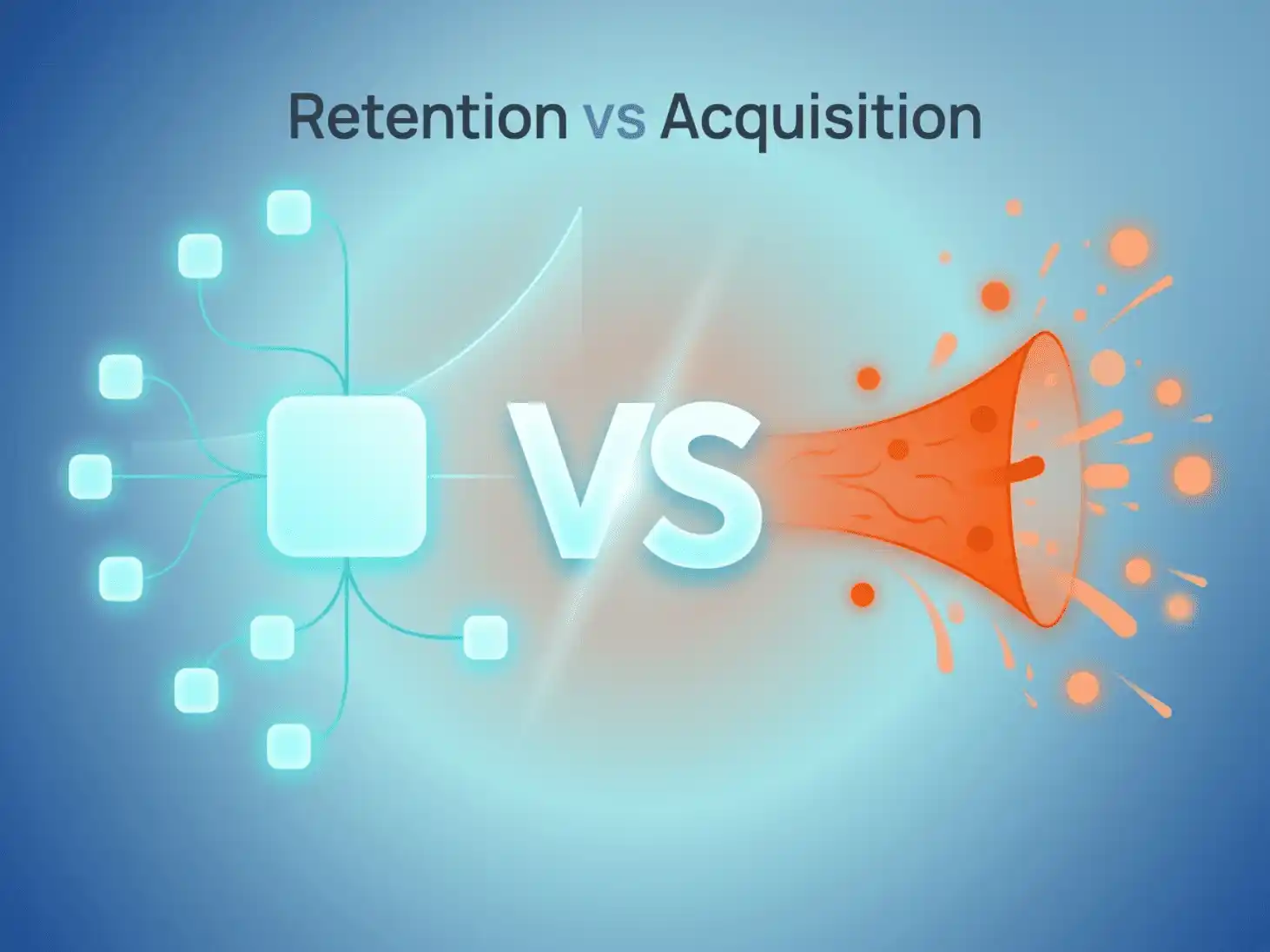
However, a Harvard Business Review study shows that acquiring a new customer costs between 5 and 25 times more than retaining an existing one. For a SaaS company, this economic reality is stark: if your churn rate is high, even rapid growth in customer acquisition masks a massive drain on your budget.
This guide breaks down the true costs of acquisition versus retention and shows you how to reallocate your investments to build profitable and sustainable growth.
1. The actual cost of acquisition vs. retention for a SaaS company
How much will it really cost to acquire a new customer in 2026?
CAC (Customer Acquisition Cost) is the sum of all marketing and sales expenses divided by the number of customers acquired during the period. But be careful: this formula masks very different realities depending on your acquisition channel and your segment.
In 2026, the average CAC for a B2B SaaS company in France ranges from $300 to $1,200, depending on the target segment. For self-service SMB SaaS, CAC hovers around $200–$400. For mid-market SaaS with longer sales cycles, it climbs to $800–$1,500. And for enterprise-level SaaS, it can skyrocket to $5,000–$15,000 per customer.
But the true cost of acquisition doesn’t stop there. You also have to factor in:
- Initial onboarding costs (setup, training, and intensive support during the first few months)
- Sales time spent on leads that don’t convert (average conversion rate: 2–5%)
- Marketing and sales tools (CRM, automation, tracking, ad platforms)
- Discounts and promotional offers (introductory discount, extended free trial)
Result: The fully-loaded CAC can be 1.5 to 2 times higher than the gross CAC you calculate in your dashboard.
Components of retention costs
Conversely, the cost of retaining an existing customer is structurally lower. It includes:
- Ongoing customer support (tickets, technical assistance)
- Customer retention tools (anti-churn platform, Customer Success, analytics)
- Customer Success resources, if you have them (CSM salaries, CS tools)
- Re-engagement campaigns and churn recovery initiatives
For an SMB SaaS company with an automated retention strategy, the cost of retention per customer typically ranges from $5 to $30 per month, or $60 to $360 per year. Even when factoring in a Customer Success team, the cost per customer remains lower than the customer acquisition cost (CAC) in most cases.
Let’s look at a concrete example: if your customer lifetime value (CLV) is $600 and your annual retention cost is $180, retaining a customer for three years costs you a total of $540, which is cheaper than acquiring a new customer to replace them.
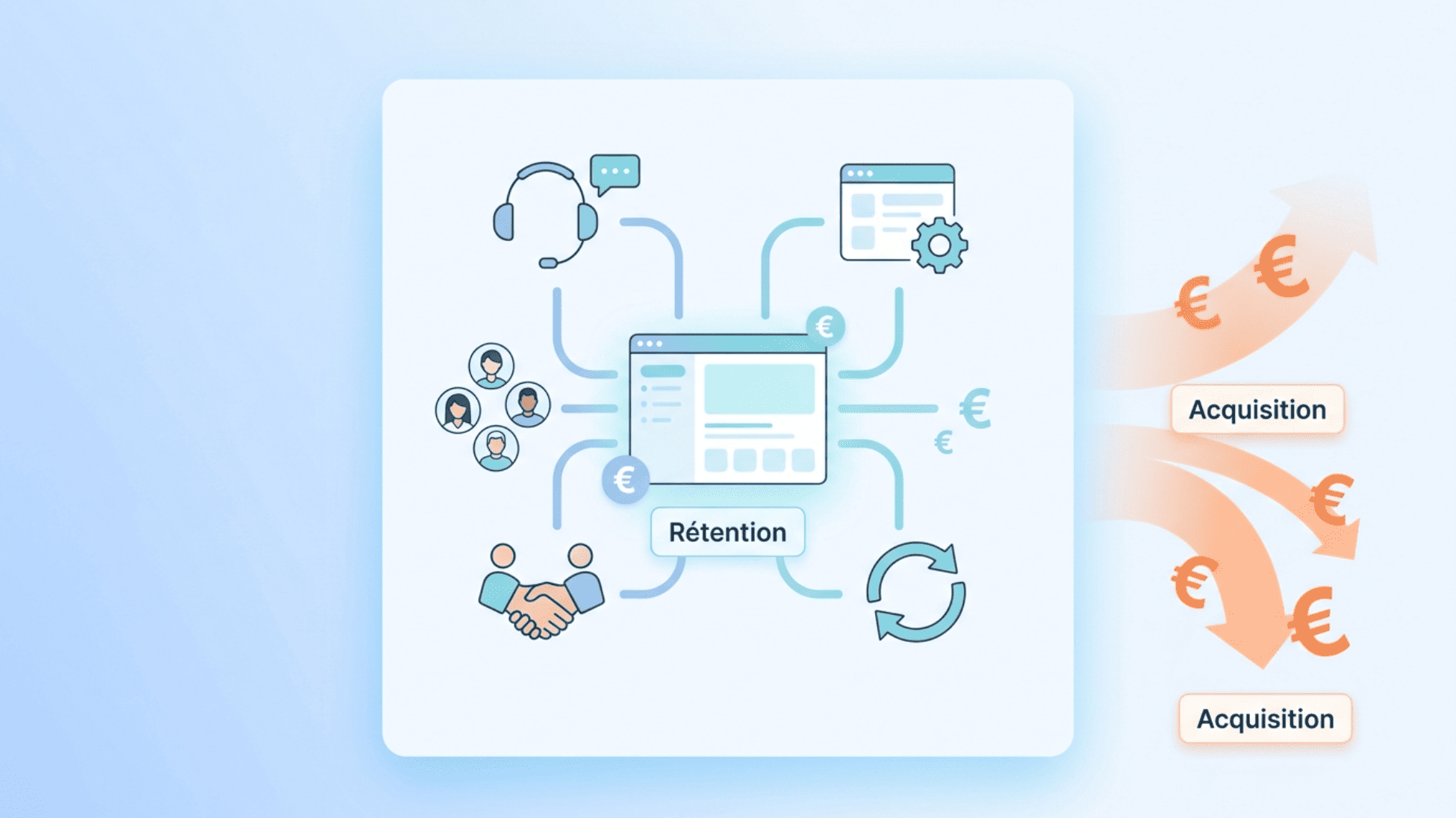
The 5x-25x ratio: where does this number come from, and is it still valid?
The often-cited statistic (“acquiring a new customer costs 5 to 25 times more than retaining an existing one”) comes from a landmark study by the Harvard Business Review published in 2014, which was itself based on research by Bain & Company.
This wide range (5x to 25x) can be attributed to differences across sectors and business models. For B2B SaaS companies, the multiple typically falls between 6x and 12x, which is still substantial.
Will this still hold true in 2026? Yes, and even more so. With the saturation of digital acquisition channels (CPM constantly rising on Google Ads and Meta), the increase in sales and marketing labor costs, and the proliferation of tools in customer stacks (meaning more competition for attention), CAC continues to rise, while the cost of retention can be optimized through automation.
| Metric | Acquisition | Retention |
| Average cost (SaaS for SMBs) | $300–$600 | $60–180 per year |
| Scalability | Rising costs | Declining costs |
| Visible ROI | 6–18 months | Immediate |
| Human dependence | Strong (sales) | Low (automation) |
2. The economic equation: why retention is more profitable
LTV and Churn: How losing a customer destroys value
Lifetime Value (LTV) is the total value a customer generates over the course of their relationship with your SaaS. It is the metric that determines whether your business model is viable or not.
The simplified formula:
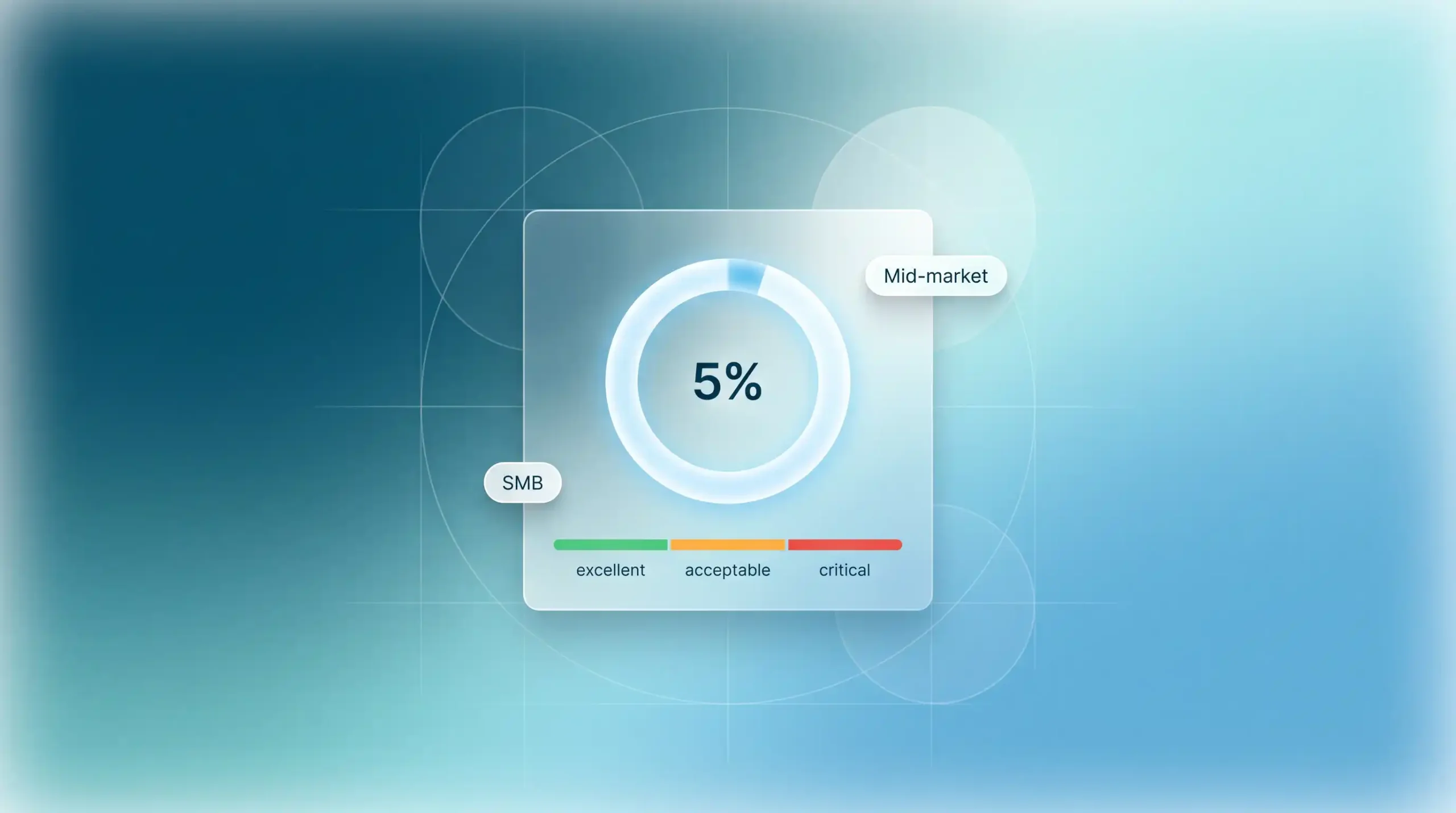
LTV = Average MRR × Gross Margin / Monthly Churn Rate A monthly churn rate of 5% = LTV of 20 months of revenue |
Let’s consider two scenarios with an average MRR of $99 and a gross margin of 80%:
- Scenario A (5% monthly churn): LTV = $99 × 0.80 / 0.05 = $1,584
- Scenario B (2.5% monthly churn): LTV = $99 × 0.80 / 0.025 = $3,168
By cutting your churn rate in half, you double your LTV without changing your pricing or your product. This is the most powerful driver of profitability for a SaaS company, and it all comes down to retention.
For a detailed look at the different types of churn and how to calculate them accurately, check out our comprehensive guide to SaaS churn, attrition, and cancellation.
Payback period: How long does it take to recoup the cost of acquiring a customer?
The payback period is the amount of time it takes to recoup your customer acquisition cost through the revenue generated by that customer. It is a critical indicator of financial health: the shorter it is, the sooner you can reinvest in growth.
| Payback period = CAC / (MRR × Gross margin) Example: $600 CAC / ($99 × 0.80) = 7.6 months |
If your monthly churn rate is 5%, your average customer lifetime is 20 months. It takes 7.6 months to recoup the cost of acquisition, and you only generate net profit for 12.4 months—just 62% of the customer lifecycle.
Now, reduce your churn rate to 2.5% (lifetime value = 40 months). You still break even in 7.6 months, but you enjoy 32.4 months of net profit—that’s 81% of the customer lifecycle. Retention radically transforms the economics of your SaaS business.
Negative Net Revenue Churn: When your existing customers fund your growth
Net revenue churn measures the loss of MRR due to churn, minus the MRR gains from expansion (upsells, upgrades, cross-sells). When this figure turns negative, it means that your existing customer base is generating more revenue than it is losing, even without new acquisitions.
The most successful SaaS companies (HubSpot, Salesforce, and Snowflake in their peak years) have achieved negative net revenue churn rates ranging from -5% to -20%. In practical terms: if you start the year at $100k MRR and make no new acquisitions, you’ll end the year at $105k–$120k MRR thanks to growth from your existing customers.
This is the ultimate goal for a SaaS company: your existing customers become your engine of growth, and every euro spent on customer acquisition becomes a value multiplier rather than simply offsetting churn.
3. The hidden costs of churn that no one calculates
Loss of future revenue (lost growth)
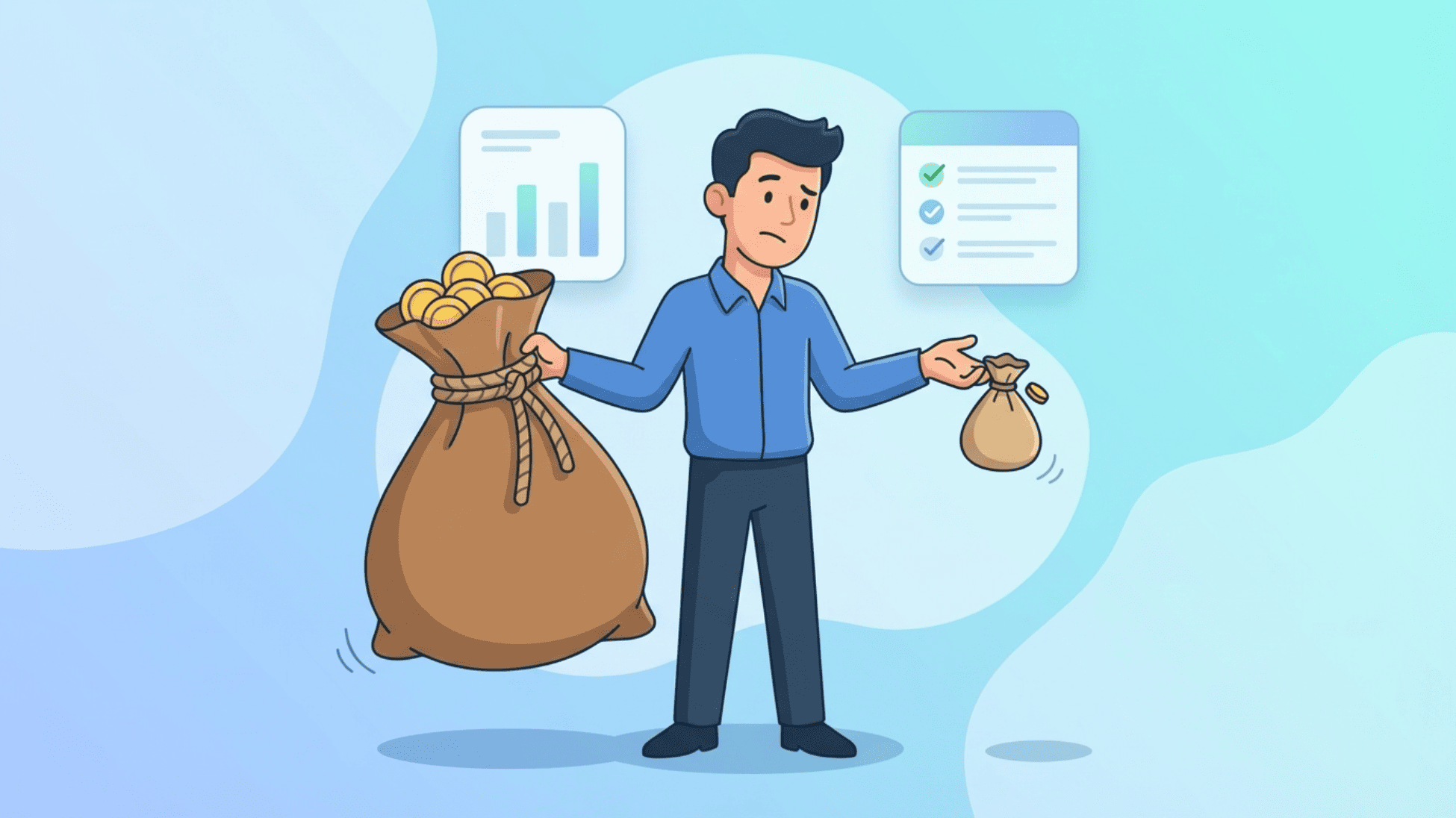
When a customer churns, you don’t just lose their current MRR—you also lose all potential for future growth. A customer paying $99/month today could have upgraded to $199/month in 12 months, and then to $399/month in 24 months.
If this customer churns after six months, you lose not only six months of MRR, but also all future growth from that account. On average, a successful SaaS company generates 20–30% of its annual MRR through expansion of its existing customer base. Every customer lost represents a lost opportunity for growth.
Calculate the opportunity cost: if your average annual growth rate is 25% and a customer paying $99/month churns after one year, you lose not only $1,188 (12 × 99), but also the $297 in potential growth, for a total of $1,485.
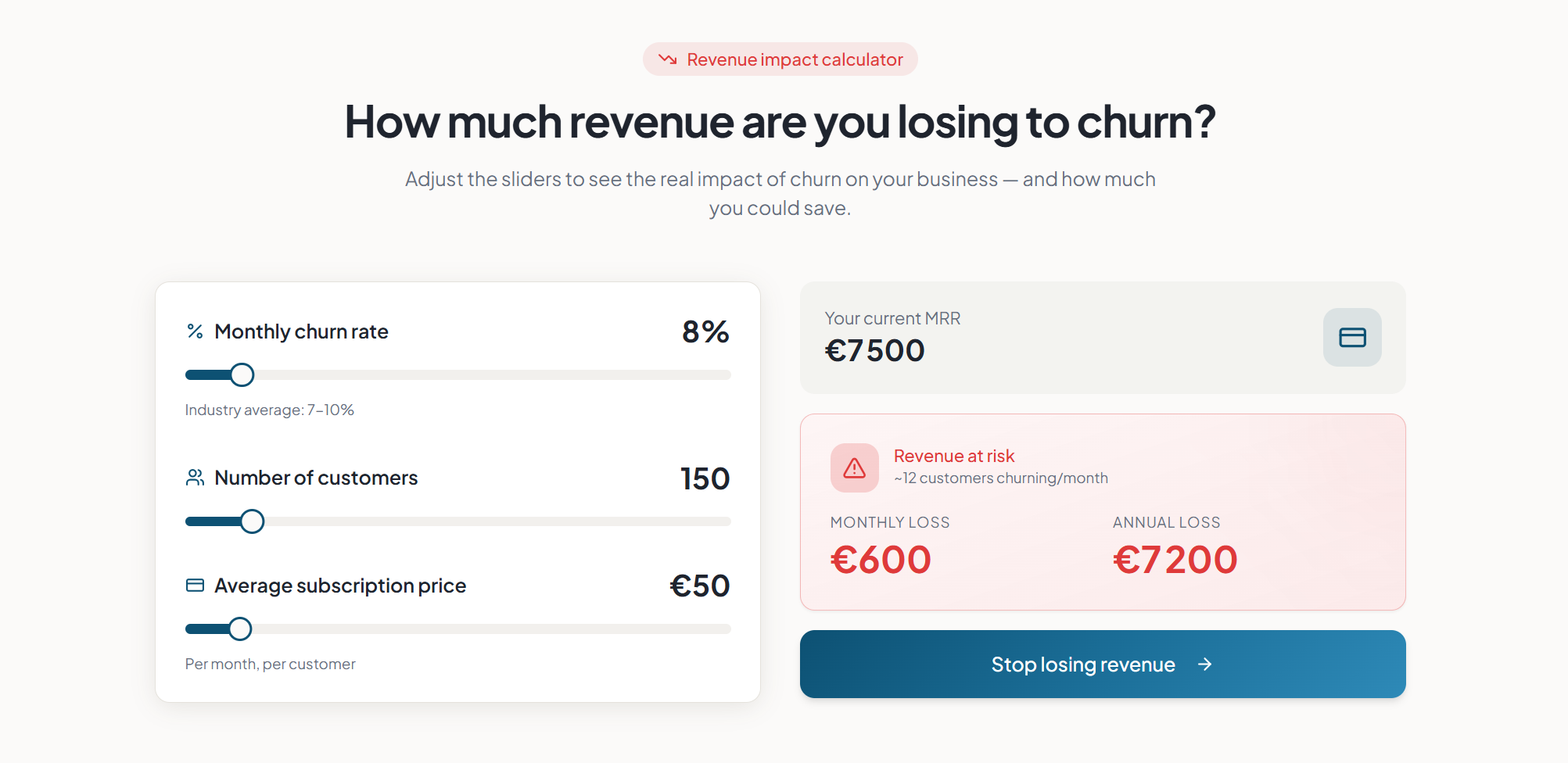
The cost of a damaged reputation and negative word of mouth
A customer who churns never goes completely silent. In B2B SaaS, founders, product managers, and IT decision-makers talk to each other on LinkedIn, in Slack communities, and at events.
A dissatisfied customer who leaves can influence 5 to 10 potential prospects in their network. If your churn is primarily due to dissatisfaction with your product or support, you’re creating negative word-of-mouth that automatically increases your future customer acquisition cost (it’s harder to convince prospects who are already biased).
Conversely, according to a Bain & Company study, increasing customer retention by 5% can boost profits by 25% to 95%, partly due to a reduction in negative word-of-mouth and an increase in recommendations.
If you want to start by reducing involuntary churn, check out our 5 ready-to-use failed payment email templates.
The impact on the valuation of your SaaS
If you’re planning a funding round or an exit, your churn rate is one of the first metrics investors will scrutinize. A monthly churn rate exceeding 5% for an SMB SaaS company is an immediate red flag that could cut your valuation in half or by two-thirds.
The valuation multiples applied by venture capital firms and acquirers are directly correlated with customer retention. A SaaS company with a 2% monthly churn rate may be valued at 8–12x ARR, while a SaaS company with a 7% churn rate will be valued at 3–5x ARR, even with the same revenue.
Investing in employee retention isn’t just about optimizing your short-term operating costs; it’s about building long-term value for your company.
4. How much to invest in customer retention (and how to optimize that budget)
The benchmark: how top-performing SaaS companies invest in customer retention
SaaS companies in the growth phase typically allocate between 10% and 25% of their total budget (marketing + sales + product) to customer retention. This percentage increases as the company matures: SaaS companies in the scaling phase may allocate as much as 30–40%.
In practical terms, for a SaaS company that spends $50,000 per month on customer acquisition, a retention budget of $5,000–$10,000 per month is reasonable. This budget covers:
- Churn detection and analysis tools (ChurnGuard, product analytics)
- Customer Success Team (if applicable) (1 CSM = $4,000–6,000/month, all-inclusive)
- Support and communication tools (Intercom, Zendesk)
- Re-engagement campaigns and recovery offers
A common mistake is to overinvest in customer acquisition (80–90% of the budget) while neglecting customer retention (10–20%). This imbalance creates a constant loss of customers that negates the impact of acquisition efforts.
To learn about the 5 practical strategies you can implement right now to reduce customer churn, check out our practical guide to reducing churn in 2026.
Automated retention vs. Customer Success: What’s the ROI?
Two main models for structuring retention, with very different ROIs:
- Automated model (data-driven anti-churn): low fixed cost (tool ~$200–500/month), ROI visible within 1–3 months, infinitely scalable. Ideal for SMB SaaS and early-stage companies.
- Human-led Customer Success model: high variable costs (CSM ~$60–80k/year), ROI visible within 6–12 months, limited scalability. Suitable for mid-market and enterprise companies with ACV > $5k.
The math is simple: if your average MRR is $49 and a CSM manages 100 accounts, that CSM needs to reduce churn for those accounts by at least 2–3 percentage points to justify their cost. If your churn is primarily involuntary or linked to product friction that can be automated, the ROI of a CSM will be low.
In contrast, an automated anti-churn platform costs $200–500 per month and can handle thousands of accounts. If it recovers even just 5–10 customers per month at $49 MRR, the ROI is immediate.
How ChurnGuard reduces the cost of customer retention
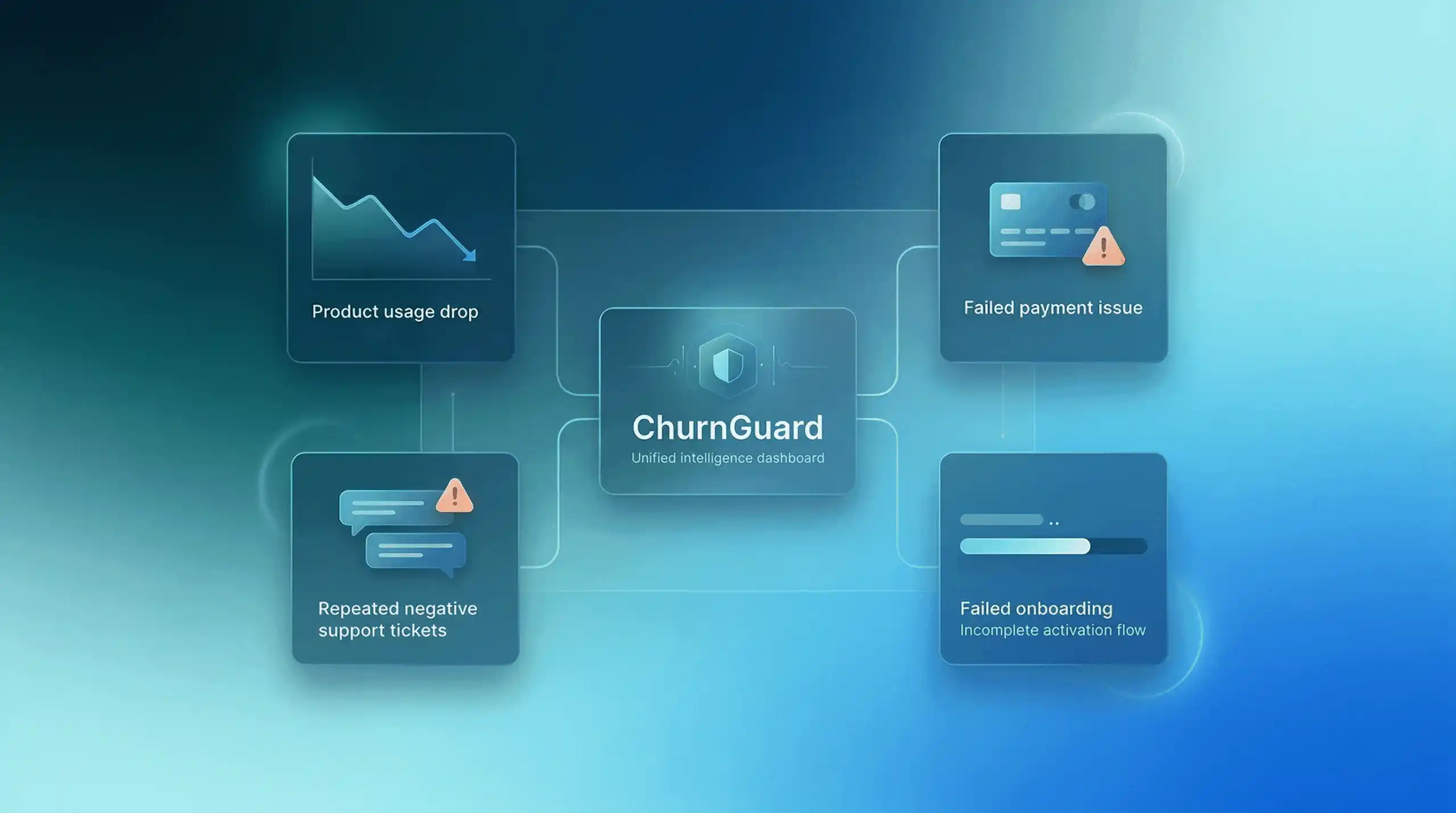
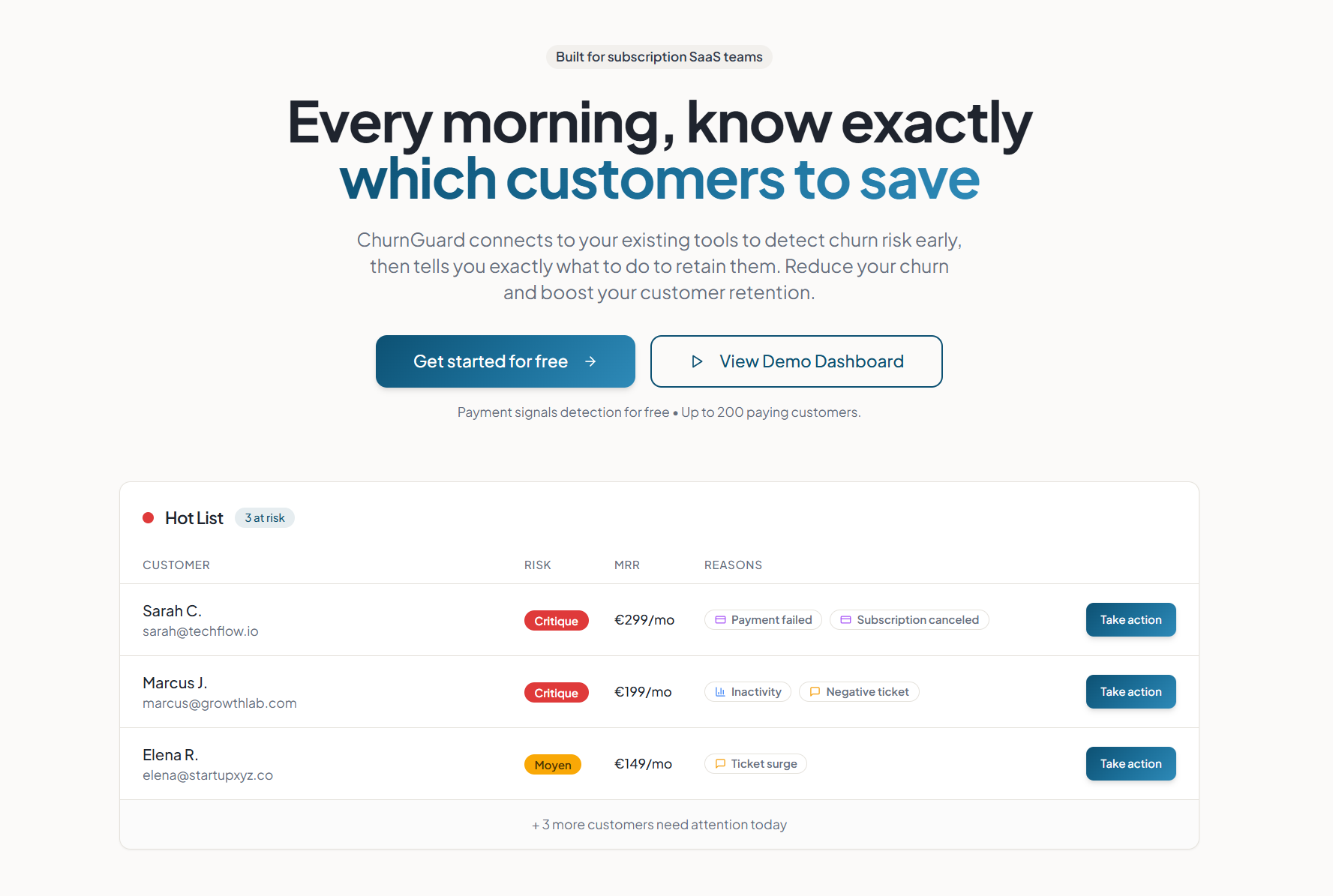
ChurnGuard helps you maximize the effectiveness of your retention budget by automating detection, prioritization, and action. Rather than having a customer service team that reacts too late to cancellations that have already occurred, ChurnGuard detects churn signals 30 to 90 days in advance and triggers corrective actions at the right time.
Concrete result:
- Reduction in involuntary churn by 30–50% (payment issues, bugs, technical glitches)
- Automatic prioritization of high-risk accounts to focus human CS resources
- Customer retention costs reduced by 3 to 5 times compared to a manual approach
For a SaaS company with 200 customers at $99 MRR and a monthly churn rate of 5%, recovering just 20% of churn using ChurnGuard translates to 2 customers saved per month—or $2,376 in annual MRR retained—at a tool cost of approximately $1,200 per year. The ROI is 2x in the first year.
Find out how ChurnGuard automates churn detection and retention efforts at churnguard.fr.
5. Acquisition vs. Retention: Finding the right balance for your stage
Early-stage phase: Don’t sacrifice retention for acquisition
The classic mistake made by SaaS companies in the seed stage is to focus entirely on customer acquisition while completely ignoring retention, under the pretext that they must first build a customer base. The result: a monthly churn rate of 7–10%, which drains the customer base as quickly as it fills it.
Even in the early stages (0–50 customers), investing at least a little in customer retention is critical. You don’t need to hire a CSM, but you should implement:
- An automated churn detection tool (ChurnGuard, analytics)
- Workflows for recovering from unintended churn (payment reminders)
- A structured onboarding process to reduce early churn (< 90 days)
With these fundamentals in place, you can aim for a monthly churn rate of 3–5% right from your first customers, which will dramatically improve your ability to raise funds or win over investors.
Growth phase: balancing the two levers
With between 50 and 200 customers, you’re entering a phase where both customer acquisition AND retention must be managed with equal rigor. Now is the time to structure your retention strategy:
- Hire a first CSM dedicated to strategic accounts (top 20% of MRR)
- Automate retention for the rest of the customer base (80% of accounts)
- Carefully measure the ROI of each retention initiative
- Segment your cohorts to identify churn patterns by channel, pricing, or industry
The goal at this stage is to reduce monthly churn to below 3% for mature cohorts (customers with more than 6 months of tenure) and maximize revenue growth from your existing customer base. If you achieve this, your growth will become much more predictable and profitable.
Phase scale: Retention becomes your competitive advantage
Once you have over 200 customers and several million in ARR, retention is no longer just about optimization—it’s your primary source of competitive advantage. At this stage, the most successful SaaS companies:
- Achieve a monthly churn rate of less than 2% (or < 22% annually)
- Generate 25–40% of their MRR growth through expansion of their existing customer base
- Have a negative net revenue churn (growth > churn)
- They allocate 30–40% of their total budget to customer retention and customer success
At this stage of maturity, every churn point avoided has a direct impact on the company’s valuation. Reducing monthly churn from 3% to 2% can increase your LTV by 50%, and thus your valuation multiple by 30–50%.
| 💡 The 40% Retention Rule SaaS companies that achieve sustainable growth allocate at least 30–40% of their total resources (budget, team, product) to retention once they’ve validated product-market fit. Those that remain in “pure acquisition” mode quickly hit a ceiling. |
Conclusion
The equation is simple but stark: in the SaaS industry, acquiring new customers costs between 5 and 25 times more than retaining existing ones. Yet most founders overspend on customer acquisition and underinvest in retention, creating a constant churn that undermines profitability.
The good news is that, unlike customer acquisition—where costs are constantly rising—customer retention can be optimized and automated to drastically reduce the cost per customer. With the right tools and strategy, you can cut your churn rate in half while spending less than 10% of your acquisition budget.
To learn more about building an effective retention strategy, check out our comprehensive guide to SaaS churn and our 5 key strategies for reducing churn.