Are you losing customers every month and wondering whether you should hire a Customer Success Manager or implement a churn prevention strategy?
These two approaches are often confused, even though they address very different issues.
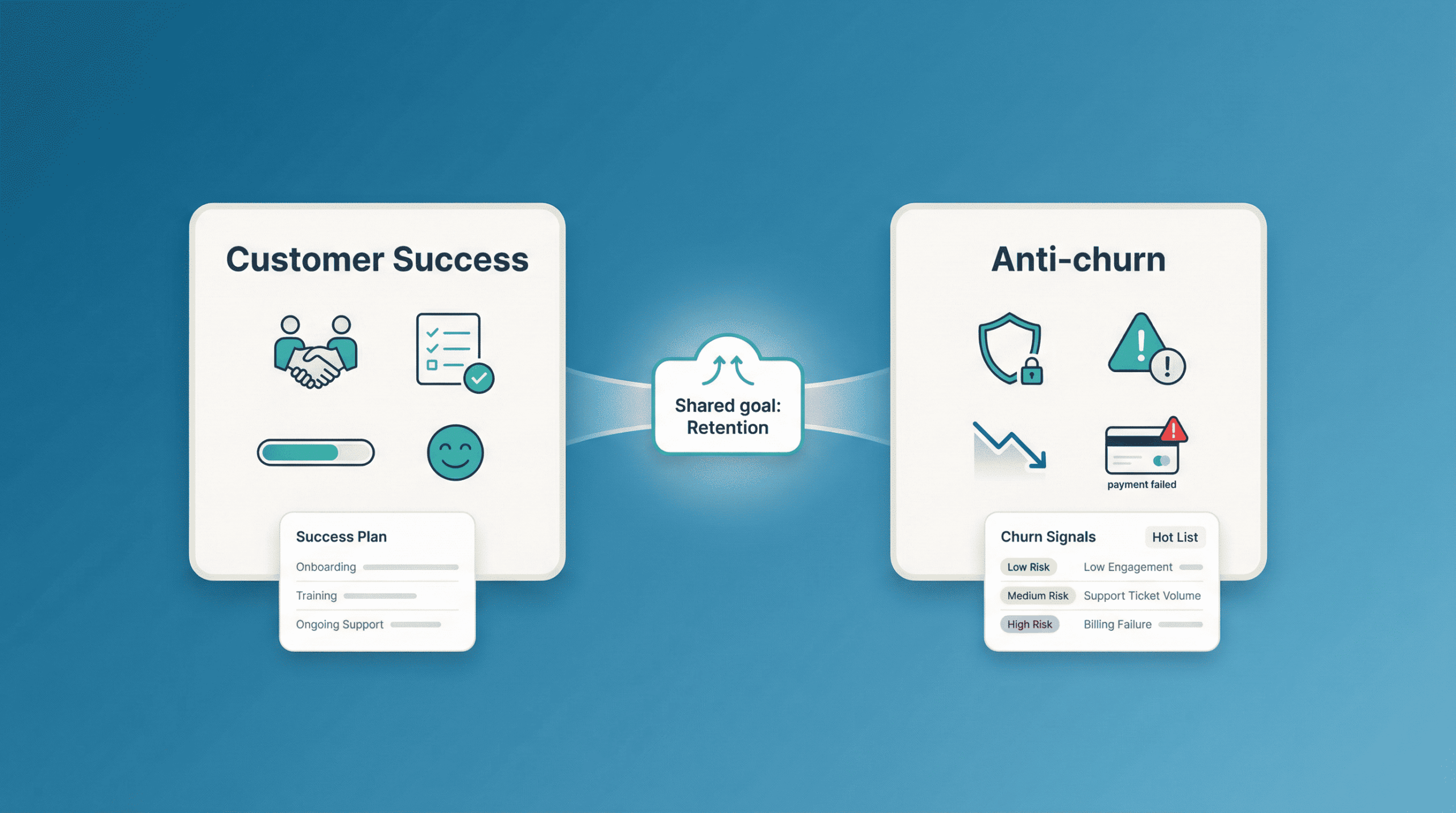
Customer Success supports your customers’ growth throughout their journey, while anti-churn identifies and addresses signs of churn before it’s too late. For a B2B SaaS company, understanding this distinction can mean the difference between passive retention and proactive retention.
This guide helps you choose the right strategy based on your stage of growth, your customer segment, and your available resources.
1. Customer success and churn prevention strategies: two complementary approaches
What is Customer Success?
Customer Success (CS) is a proactive approach designed to ensure that your customers achieve their goals using your product. The Customer Success team supports customers from the moment they onboard, helps them adopt key features, identifies opportunities for growth (upsells, cross-sells), and builds a long-term relationship based on trust.
Customer Success doesn’t just step in when there’s a problem; it works proactively to maximize the value customers perceive and build a lasting relationship. It’s a role that combines consulting, proactive support, and account management.
What is a customer retention strategy?
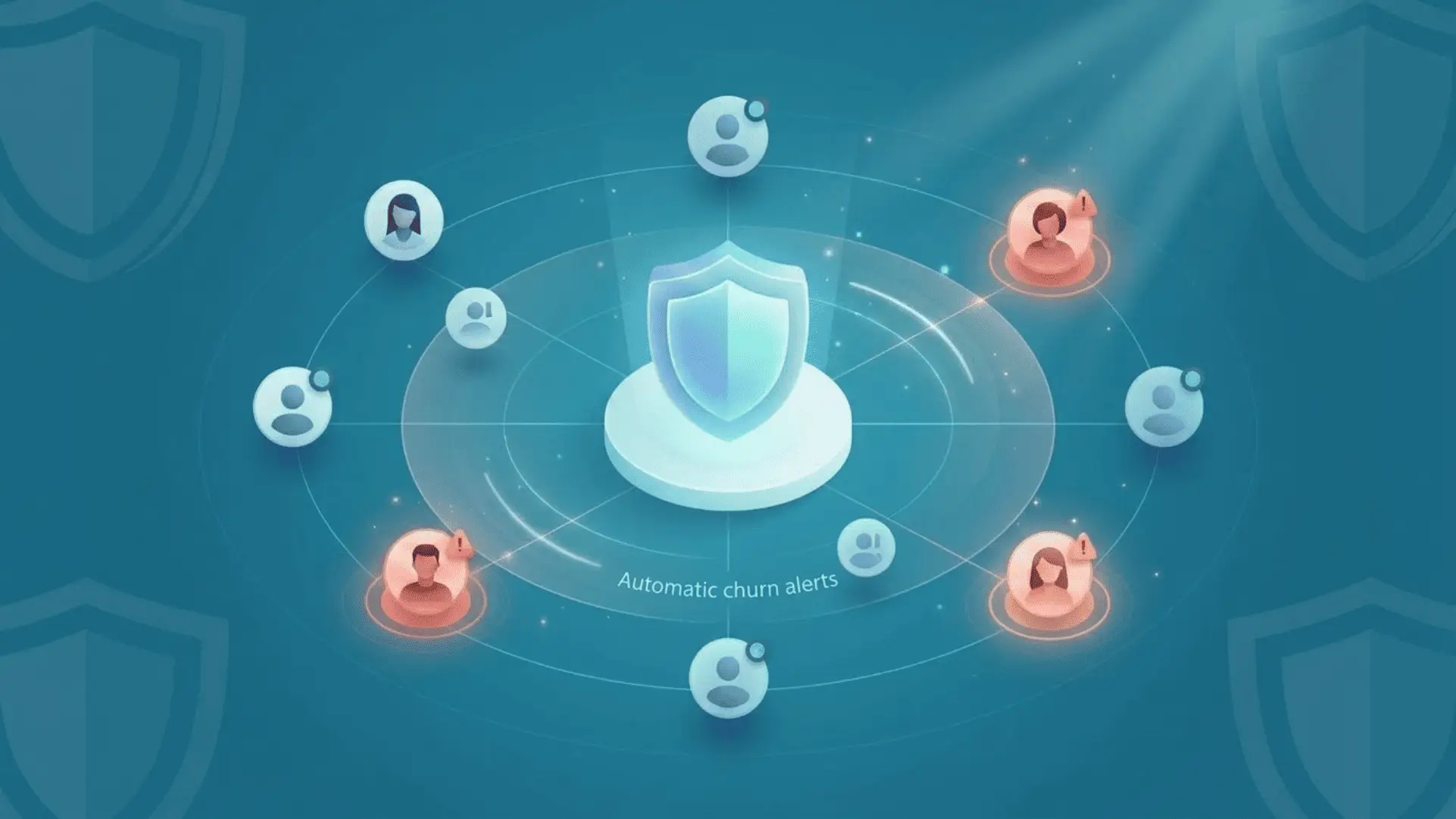
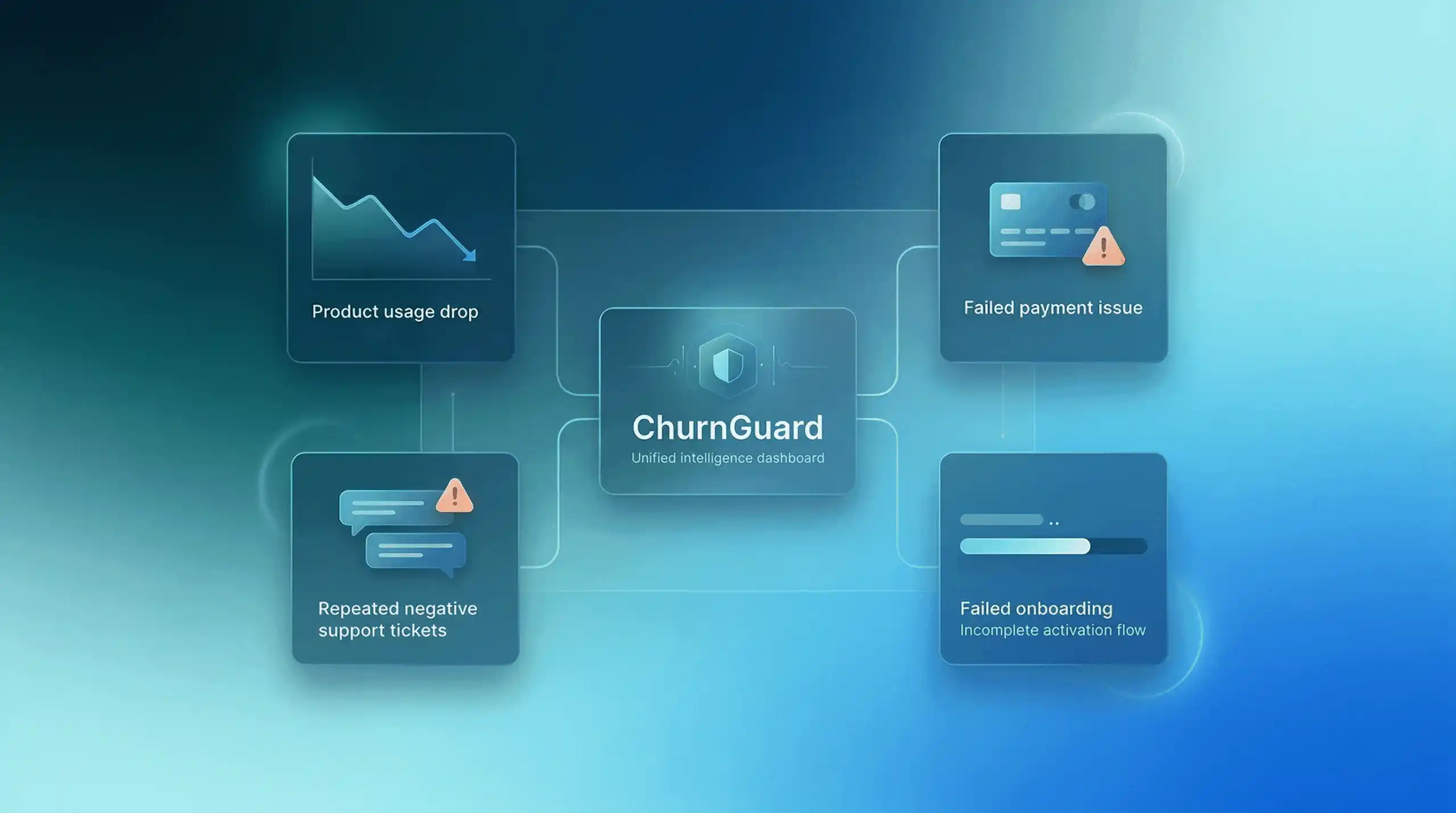
An anti-churn strategy, on the other hand, focuses specifically on detecting and preventing customer churn. It relies on analyzing risk indicators (decreased product activity, payment failures, unresolved support tickets, etc.) to identify customers at risk of churn and trigger targeted corrective actions before they cancel their service.
Anti-churn strategies are often automated and data-driven: rather than providing uniform support to all customers, they prioritize interventions for those showing the most critical signs of churn. The goal is simple: to prevent avoidable losses.
For an in-depth understanding of the different types of churn and how to calculate them, check out our comprehensive guide to churn, attrition, and cancellation for SaaS companies.
Why are they often confused?
The confusion stems from the fact that Customer Success and anti-churn share a common goal: customer retention. Many SaaS founders believe that by hiring a Customer Success Manager, they automatically solve their churn problem. In reality, these two approaches focus on different levers. Customer Success targets all customers to create value throughout the entire lifecycle. Anti-churn, on the other hand, intervenes in a targeted manner at critical moments when a customer is about to leave. One is comprehensive and ongoing, the other is ad hoc and reactive, but both are necessary depending on your context.
2. The fundamental differences between Customer success and anti-churn
Main objective: Proactivity vs. Reactivity
Customer Success is inherently proactive: it anticipates the customer’s needs, supports them as they develop their skills, and seeks to create value even before the customer asks for it. It is an approach based on ongoing support.
Although anti-churn relies on early detection, it remains fundamentally reactive: it intervenes in response to departure signals that have already been identified. The goal is not to build a long-term relationship, but to retain a customer who is at immediate risk of cancellation.
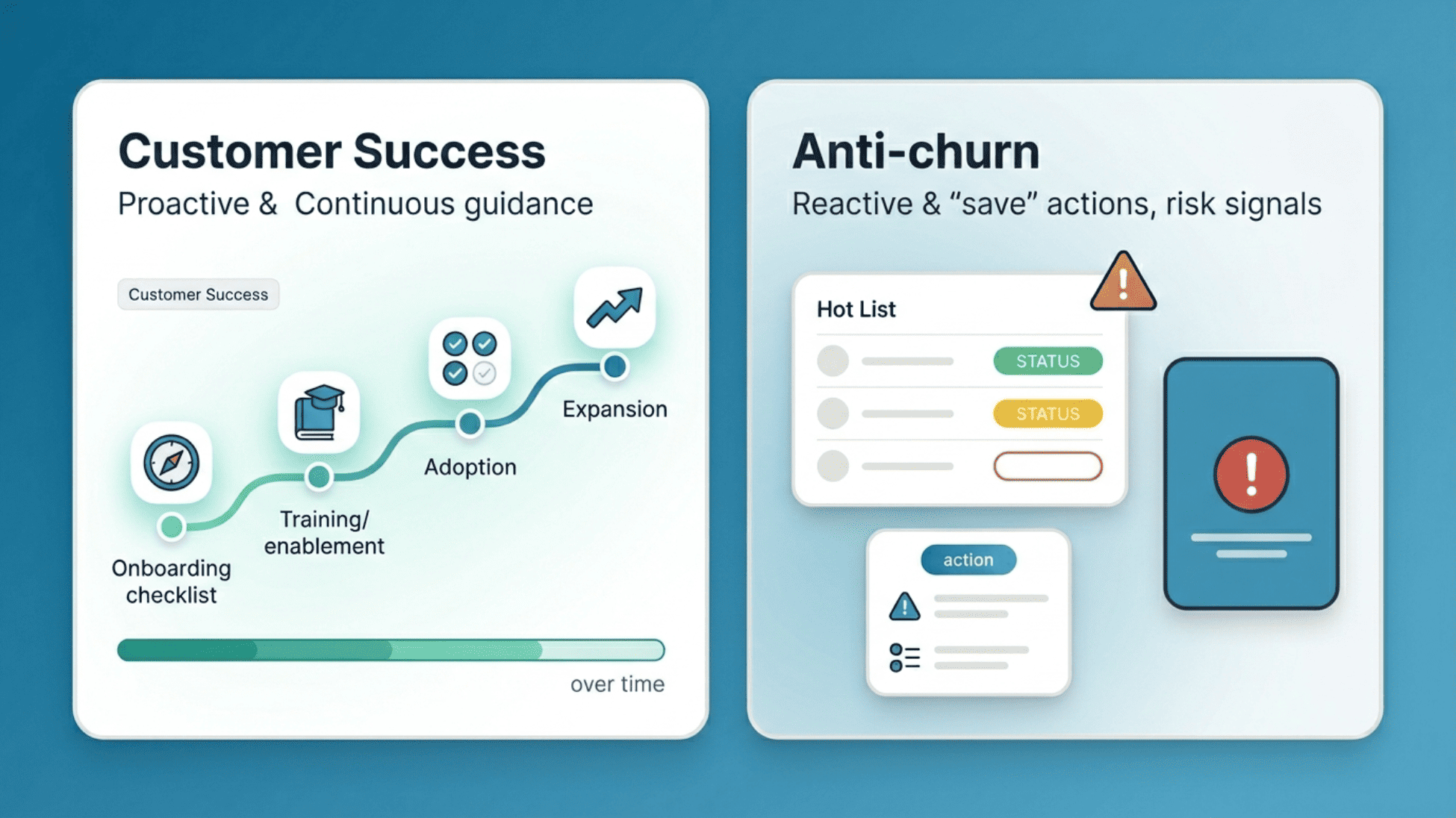
Scope of action: comprehensive support vs. early warning detection
Customer Success covers the entire customer journey: onboarding, adoption, engagement, expansion, and renewal. It encompasses functional aspects (understanding the product), strategic aspects (aligning usage with business objectives), and relational aspects (building trust).
Anti-churn, on the other hand, focuses on a much narrower scope: detecting risk signals and triggering corrective action. It doesn’t deal with growth or customer education, its sole priority is to prevent churn.
Timing of intervention: throughout the customer lifecycle vs. the critical pre-churn window
Customer Success gets involved from day one of the customer relationship and maintains regular contact throughout the customer lifecycle, often through quarterly check-ins, business reviews, and support for new features.
Anti-churn, on the other hand, is only triggered when churn signals are detected, typically within 30 to 90 days of a potential cancellation. It is a one-time intervention focused on a critical window of opportunity when there is still time to take action.
Required resources: human staff vs. automation and data
Customer Success requires significant human resources. A CSM can manage between 30 and 150 accounts depending on the level of support required, which entails significant payroll costs—typically between $50,000 and $80,000 per year per CSM in France.
Anti-churn, on the other hand, relies primarily on automation and data analysis. Once detection rules are configured and intervention workflows are in place, the system runs autonomously with minimal human intervention. This is a much more financially scalable model. Especially since, according to Harvard Business Review, acquiring a new customer costs 5 to 25 times more than retaining an existing one, making retention absolutely critical to the profitability of a SaaS business.
| Criterion | Customer Success | Anti-churn |
| Approach | Proactive and ongoing | Responsive and punctual |
| Cost | High ($50,000–80,000 per CSM per year) | Low (tool + automation) |
| Scalability | Limited (30–150 accounts/CSM) | Very high (unlimited) |
| Visible ROI | Long term (6–12 months) | Short term (1–3 months) |
3. When is an anti-churn strategy sufficient (or should be a priority)?
You are an early-stage SaaS company with limited resources
In the early stages of a SaaS company’s growth, budgets are tight, and every euro invested must deliver a measurable impact quickly. Hiring a CSM at $60,000 a year before you’ve validated the ROI is a risky move, especially if you don’t fully understand your churn rate.
Anti-churn helps you streamline your retention efforts with minimal investment: by identifying the main causes of churn and automating corrective actions, you can reduce churn without dedicating additional human resources.
Check out our dedicated article for 5 practical strategies to reduce customer churn, even with limited resources.
You’re targeting SMBs with a self-service product
The SMB (small and medium-sized businesses) segment is characterized by a low average order value and a large customer base. In this context, the unit economics of a dedicated account manager don’t add up: it’s impossible to justify spending one hour of staff time per month on a customer who pays $49.
The self-service model is based precisely on customer autonomy and the automation of customer journeys. A data-driven anti-churn strategy fits perfectly into this approach: it detects friction points without human intervention and triggers automated actions (emails, in-app messages, downgrade offers) that address churn on a large scale.
Your churn is primarily involuntary (payment-related, technical)
If a significant portion of your churn is due to factors beyond your control (expired credit cards, failed payments, technical glitches, renewal emails not received, etc.), Customer Success is not the right solution. These customers aren’t leaving because they’re dissatisfied, but because an operational issue is preventing them from staying.
Anti-churn effectively addresses this type of churn through automated follow-up systems, workflows for updating payment methods, and technical alerts. It is an engineering and automation issue, not a customer relationship issue.
You have a large customer base and a low average order value
When you manage 500 customers at $29/month, the total monthly revenue is $14,500. Even assuming that a CSM reduces churn by 3 percentage points (which is an optimistic estimate), the monthly impact would be $435, far from covering their salary.
In this scenario, automated anti-churn becomes the only economically viable option. Rather than trying to build a one-on-one relationship that’s impossible to make profitable, you address churn through automated segmentation and targeted actions based on predictive rules.
4. How to effectively combine customer success and churn prevention
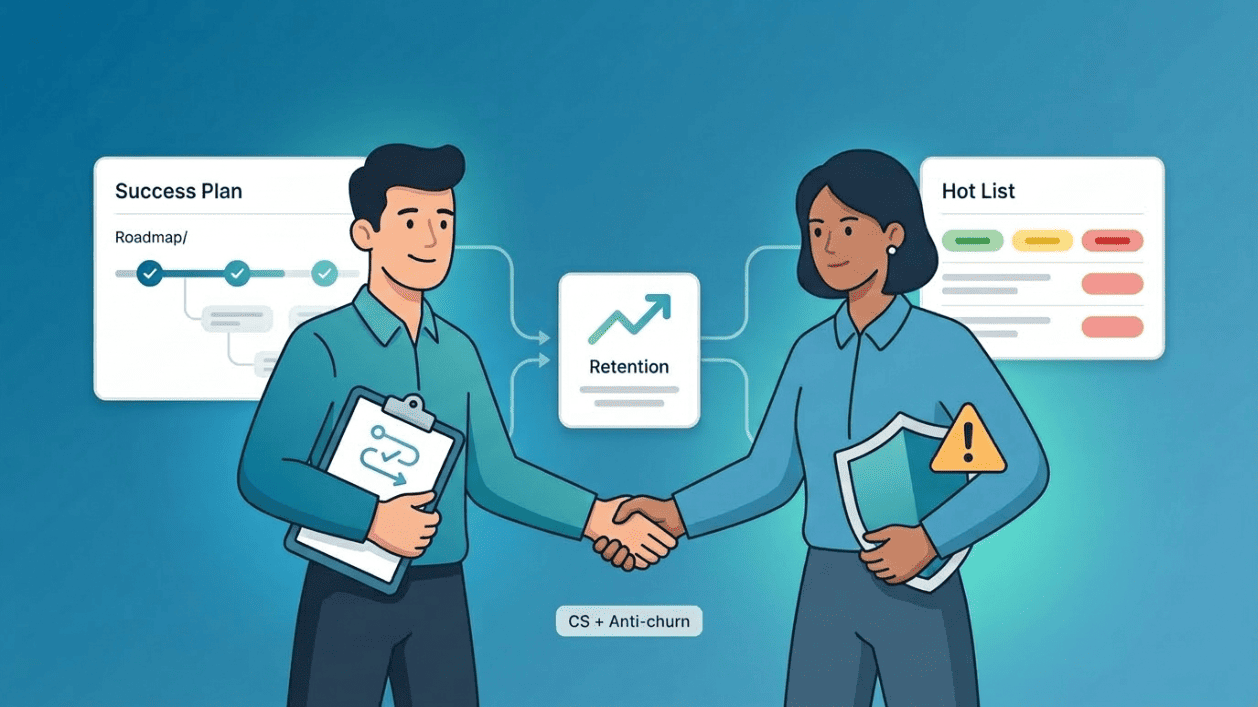
Use anti-churn strategies to prioritize customer service interventions
The biggest challenge for a Customer Success team is prioritization: with dozens or even hundreds of accounts to manage, it’s impossible to give the same level of attention to every single one. This is where anti-churn becomes a strategic tool for CS: by identifying at-risk accounts through automated scoring, you enable your CSMs to focus their time on the customers who really need it.
Rather than making generic, scheduled touchpoints, your CSM teams take targeted action on accounts flagged as high-risk by the anti-churn system, with specific context regarding the reason for the risk (declining usage, frustration with support, etc.). The result: more effective interventions and a better ROI on CSM time.
Automate repetitive tasks to free up time CS
Much of the work involved in customer retention does not require human intervention. Payment reminders, re-engagement emails following a drop in activity, and downgrade offers for customers facing financial difficulties, all of these can be automated through a churn prevention strategy.
By delegating these repetitive tasks to automated workflows, you free up CS time for high-value interactions: strategic guidance, identifying growth opportunities, and resolving complex cases. The CS team can focus on what they do best (building relationships and providing advice) while the anti-churn team handles the day-to-day operations.
5. Segment your customer base: Human customer service for high-value customers, automated anti-churn measures for the rest
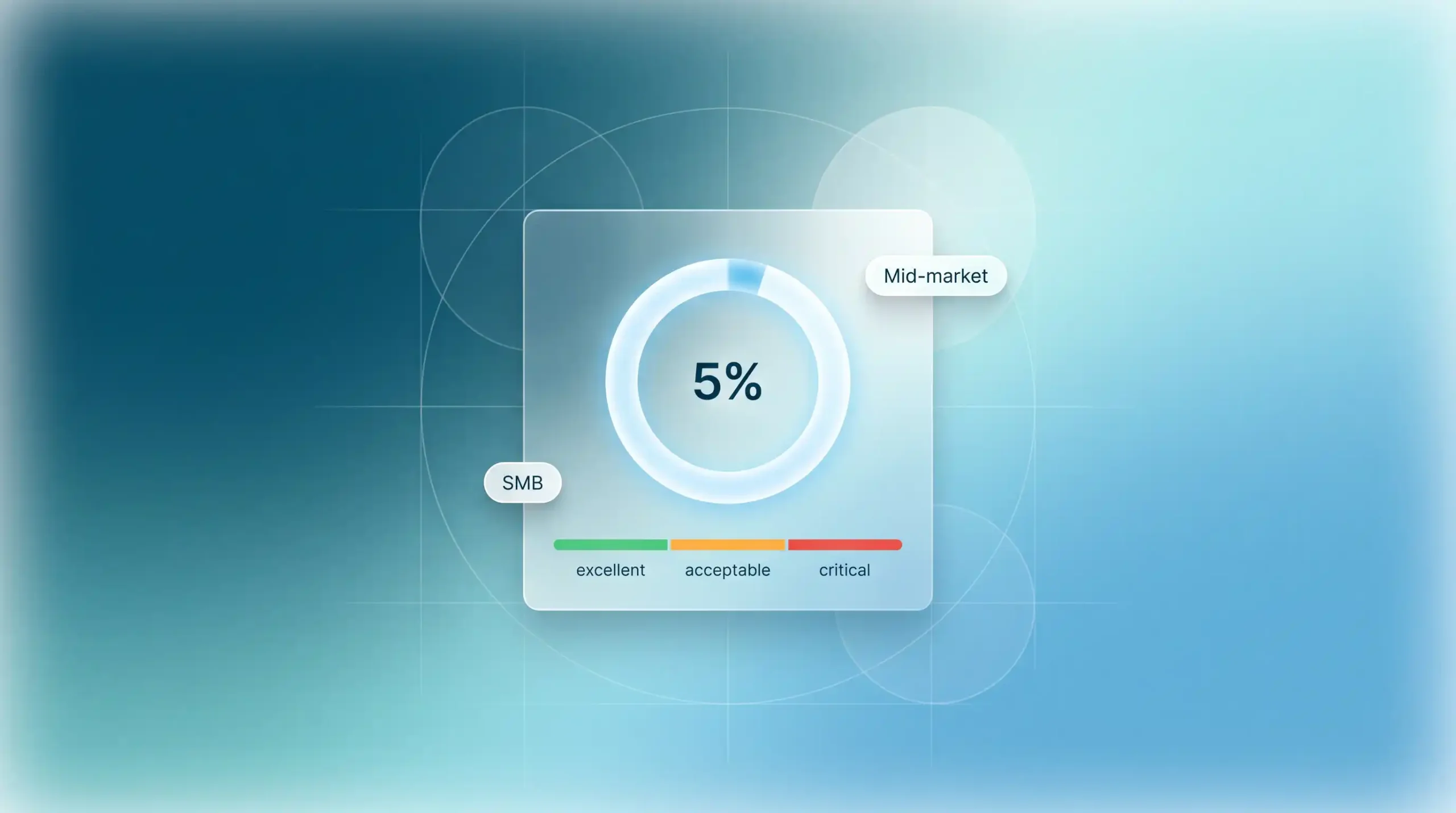
Segmentation is key to a profitable retention strategy. Not all of your customers warrant the same level of relationship investment. A hybrid approach involves reserving human customer success support for strategic accounts (typically those that account for 80% of your MRR) and handling the rest through an automated anti-churn system.
In practice: Your enterprise and mid-market clients have a dedicated CSM who proactively supports them, while your SMB clients are managed by automated systems that detect risks and trigger actions without human intervention. This allows you to maximize the value created per euro invested in retention. Research by Bain & Company shows that increasing retention by just 5% can boost profits by 25% to 95%, a growth lever often underestimated by hyper-growth SaaS companies focused solely on acquisition.
Measuring the combined impact: churn reduction + revenue growth
The effectiveness of a combined CS and anti-churn strategy is measured not only by the reduction in churn but also by the revenue growth it generates. Customer Success should contribute to negative net revenue churn by identifying upselling and cross-selling opportunities, while anti-churn efforts minimize losses.
Key metrics to track: overall churn rate, net revenue churn, LTV/CAC ratio, and CS contribution to MRR growth. If your CS team reduces churn by 2 percentage points but drives 15% annual revenue growth, the combined ROI becomes clear, even with high payroll costs.
6. ChurnGuard as a key asset in this strategy
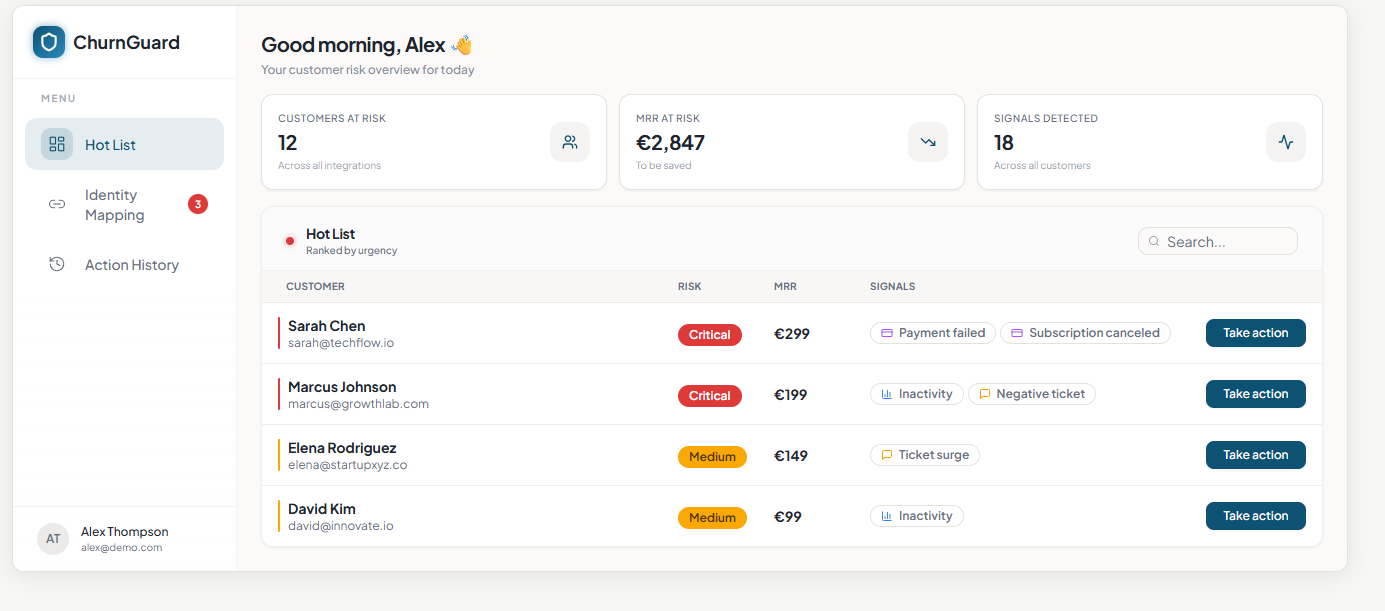
ChurnGuard detects warning signs so your customer service team can step in at the right time
The main challenge facing Customer Success teams isn’t a lack of skills, but a lack of visibility into at-risk customers. Without an automated detection system, CSMs often only discover the risk of churn when the customer announces their intention to cancel, by which point it’s too late to take effective action.
ChurnGuard solves this problem by centralizing churn signals from your various tools (billing, usage, support) and generating a real-time risk score for each account. Your CSMs receive alerts as soon as a customer enters the danger zone, along with specific context on the reason for the risk, enabling them to intervene at the right time with personalized and tailored retention proposals.
Automate anti-churn efforts to free up CS time for high-value accounts
For accounts with low average order values that do not warrant human intervention, ChurnGuard takes over with automated actions. As soon as a churn signal is detected, the system triggers an appropriate recommended action: a personalized re-engagement email for an inactive customer, a smart payment reminder for a failed billing transaction, or a downgrade offer for a customer facing financial difficulties.
The result: your CSMs can focus 100% of their time on strategic accounts, while ChurnGuard automatically handles retention for the rest of your customer base. It’s the perfect balance between scalable automation and high-value human interaction.
Measuring impact: reducing churn + optimizing CS time
ChurnGuard doesn’t just detect and alert—it also measures the effectiveness of your retention efforts. You can track in real time how many customers have been retained thanks to CS interventions triggered by alerts, which type of signal generates the highest recovery rate, and which action channel (email, phone call, in-app) yields the best results.
This data allows you to continuously optimize your retention strategy: if you find that Customer Success interventions with customers in the red zone—due to a decline in usage—have a 60% success rate, you know where to focus your efforts. Data-driven anti-churn strategies and human Customer Success reinforce each other.
7. Mistakes to avoid in your customer retention strategy
Hiring a customer support team too early without churn data
A common mistake made by early-stage SaaS companies is hiring a CSM before conducting a thorough analysis of their churn rates. As a result, the CSM spends their time providing reactive support or handling operational tasks, with no measurable impact on retention, because the root causes of churn have not been identified.
Before hiring for Customer Success, first invest in understanding your churn: Which segments are churning the most? What warning signs precede churn? What percentage is involuntary versus voluntary? Once you have clear answers to these questions, you’ll know whether you need human CS representatives or if automated anti-churn measures are sufficient.
Believing that CS alone will solve the churn problem
Customer Success is a powerful tool for retention, but it doesn’t solve everything, especially not structural churn caused by a poor product-market fit, inappropriate pricing, or recurring product bugs. Hiring a CSM when your product isn’t delivering on its promises will only delay customer churn, not prevent it.
CS should be part of a comprehensive retention strategy that also includes product improvements, optimized onboarding, and addressing involuntary churn. It is a complementary measure, not a silver bullet.
Neglecting involuntary churn in favor of relationship-building
Many SaaS companies invest heavily in Customer Success to address voluntary churn (dissatisfaction, competition, no longer needing the service), while completely ignoring involuntary churn, which accounts for 20 to 40% of customer departures. The result: costly human resources are tied up in complex cases, while hundreds of customers quietly leave because their credit cards have expired.
Data from Stripe shows that automated follow-up systems can recover between 30% and 50% of failed payments. Automated anti-churn effectively addresses involuntary churn with an immediate and measurable ROI. It is often the most accessible quick win for reducing your overall churn rate, even before hiring customer success staff.
Failing to measure the ROI of your retention efforts
Without rigorous metrics, it’s impossible to know whether your retention investments are paying off. How many customers did your CS team actually retain this quarter? What is the cost of acquiring a single prevented churn? Which action yields the highest recovery rate?
An effective retention strategy relies on data: tracking interactions, attributing conversions, and analyzing success patterns. If you don’t measure, you’re flying blind, and you risk overinvesting in low-impact initiatives.
If you’re unsure whether to focus on acquisition or retention efforts, check out our comparison of the two options.
Conclusion
Customer Success and anti-churn strategies are not mutually exclusive; they complement each other. Customer Success builds long-term value and guides strategic clients toward success, while anti-churn strategies detect and address warning signs of churn before it’s too late, in a scalable and automated manner.
For a B2B SaaS company, the question isn’t about choosing one over the other, but about finding the right balance based on your stage of growth, your customer segment, and your available resources. In the early stages, data-driven anti-churn strategies should be your priority. As you scale, combining both approaches becomes a decisive competitive advantage.
To learn more about building an effective retention strategy, check out our 5 key strategies for reducing churn.