Between analytics tools that overwhelm you with data, overpriced customer success platforms, and solutions that promise miracles but never deliver, choosing the right anti-churn tool is a real challenge.
This 2026 comparison reviews the best solutions on the market, their strengths, their limitations, and most importantly: which one truly matches your SaaS profile and your type of churn.
1. What is a customer retention tool, and what is its actual purpose?
The difference between an anti-churn tool and a Customer Success platform
There is often confusion: an anti-churn tool is not a Customer Success platform. CS platforms (Gainsight, Totango, ChurnZero) are comprehensive suites designed to manage the entire customer lifecycle, lead a Customer Success team, track complex health scores, and orchestrate multi-step playbooks.
A pure anti-churn tool, on the other hand, focuses on a single goal: detecting signs of churn and triggering actions to prevent cancellations. No customer CRM, no CS task management, no lengthy dashboards. Just detection, prioritization, and action.
For an SMB SaaS company without a dedicated CS team, a comprehensive Customer Success platform is often overkill and underutilized. A targeted anti-churn tool is more than sufficient and costs 5 to 10 times less.
To learn more about this topic, check out our article ‘Customer Success vs. Anti-Churn: What’s the Difference for a B2B SaaS Company?’
The 3 pillars of an effective anti-churn tool (detection, prioritization, action)
An effective anti-churn tool is based on three inseparable pillars:
- Churn detection: The tool must cross-reference multiple data sources (billing, product usage, support, etc.) to identify at-risk customers. The earlier it detects churn, the more time you have to take action.
- Automatic prioritization: Not all at-risk customers are created equal. A good tool assigns a risk score and tells you which ones to focus on first (typically: accounts with high MRR and critical warning signs).
- Action recommendation: Detection alone isn’t enough. The tool should tell you exactly what to do: what message to send, through which channel, and with a value proposition tailored to the detected signal.
Many tools on the market excel at detection but fall short when it comes to taking action. The result: you know that customers are at risk, but you still don’t know how to save them.
2. Key criteria for choosing your anti-churn tool
Seamless integration with your existing tools
An anti-churn tool is only valuable if it can connect to your data sources. Key integrations to check:
- Billing tools: Stripe, Paddle, Chargebee (to detect payment failures, downgrades, and cancellations)
- Product analytics: Mixpanel, Amplitude, PostHog, or your own database (to track usage)
- Customer support: Zendesk, Intercom, Helpscout (to identify frustration tickets)
- Email and communication: to identify emails expressing frustration or automatically trigger retention actions
If the tool requires custom development to connect to your stack, the time to value skyrockets and you lose the benefit of automation. Opt for solutions with native, plug-and-play integrations.
Proactive Approach vs. Analytical Approach
This is THE key difference between the tools available on the market, and it determines how effective they really are at reducing your churn.
- Analytical approach (most tools): These solutions draw on historical data. They provide dashboards showing your churn rates, lost cohorts, and historical trends. They can send alerts when a customer falls below a certain threshold. But fundamentally, they analyze what has already happened rather than taking action on what is currently happening.
- Proactive approach (less common): These solutions detect signals in real time and immediately trigger a recommended action. As soon as a customer shows signs of churn (decreased usage, failed payment, negative feedback), the tool tells you exactly what to do right away to retain them: which message, which channel, and which offer.
Cost and ROI: How much to invest based on your stage of growth
Prices vary widely depending on the solution:
- Lightweight anti-churn tools: $100–500/month (ChurnGuard, Baremetrics)
- Comprehensive customer success platforms: $1,000–$5,000 per month (ChurnZero, Vitally, Totango)
- Enterprise solutions: $5,000–$20,000 per month (Gainsight)
The ROI calculation is simple: if the tool helps you win back even just 2 or 3 customers per month at $99 MRR, it pays for itself. But be wary of over-engineered platforms that cost more than the value of the customers they help you retain.
Ease of setup and time-to-value (how long it takes to see the first results)
Some solutions require several weeks of implementation, custom development, and complex configuration before they produce any results. Others are up and running in less than 24 hours.
For early-stage or growth-stage SaaS companies, time-to-value is critical. You can’t afford to wait two months before seeing the first churn alerts. Choose tools that connect in just a few clicks and start detecting issues immediately.
3. Comparison of the best anti-churn tools for 2026
ChurnGuard: Automatic detection and recommended actions for SaaS
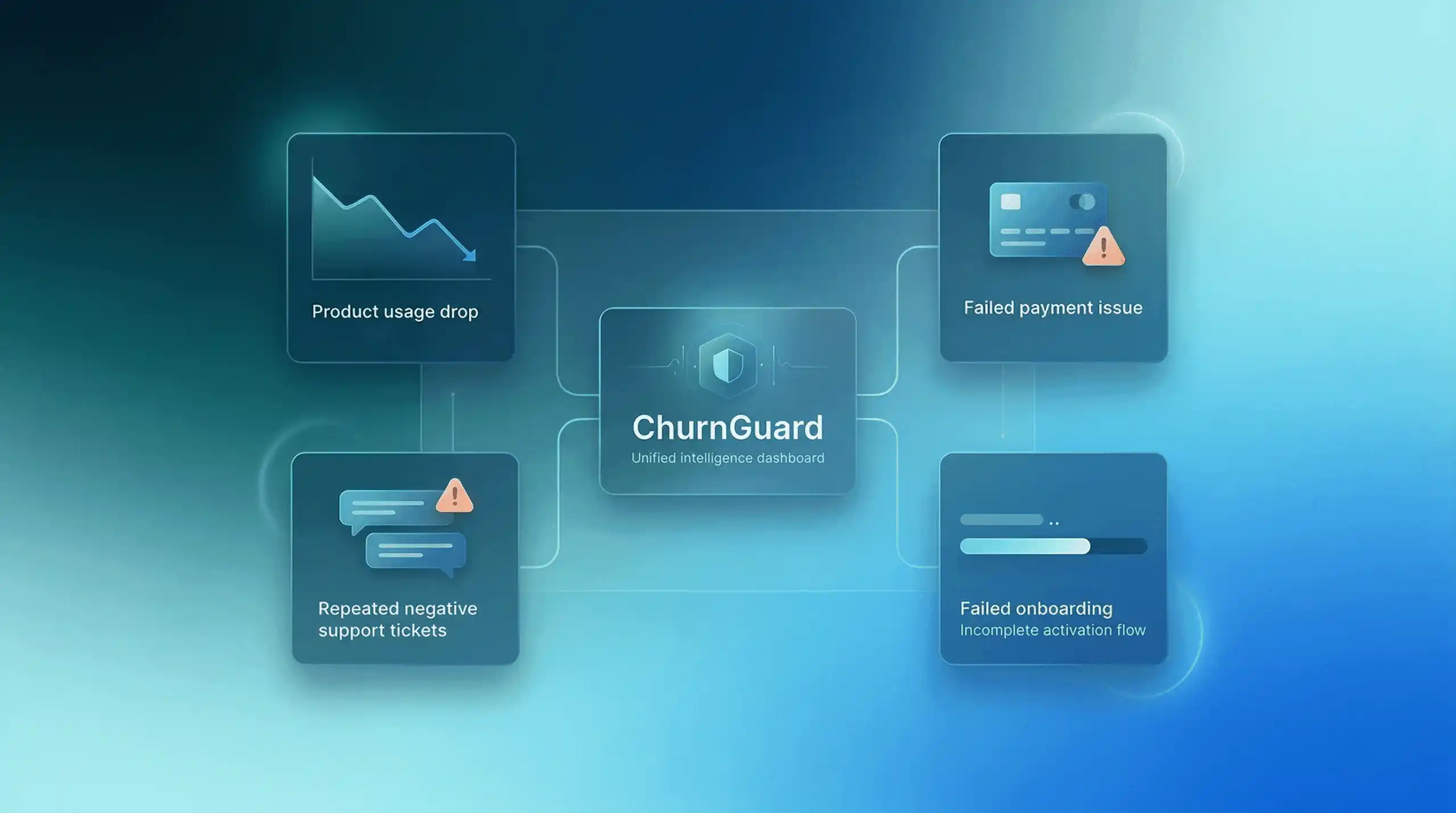
ChurnGuard is a proactive anti-churn tool specifically designed for early-stage and growth-stage SaaS companies. It integrates with your existing tools (Stripe, Supabase/PostgreSQL/Posthog, Zendesk, Gmail, etc.) and detects churn signals in real time across three dimensions: billing, product usage, and support.
- Key strengths: a proactive approach with immediate recommended actions, setup in under 10 minutes, native integrations with the standard SaaS stack, affordable pricing (starting at $99/month), interface available in French and English, responsive support.
- Ideal use case: SaaS companies in the SMB and mid-market segments (100 to 10,000 customers) without a dedicated Customer Success team, looking to automate customer retention without investing in a full-fledged CS platform.
- Price: Free for up to 200 paying customers online, then starting at $99/month.
ProfitWell Retain: Specializing in reducing involuntary churn
ProfitWell Retain (acquired by Paddle) focuses exclusively on involuntary churn caused by payment failures. It uses intelligent dunning workflows and optimized payment reminders to recover expired cards and failed payments.
- Key strengths: highly effective at reducing involuntary churn (can recover 30–50% of failed payments), robust Stripe integration, performance-based pricing (a percentage of recovered revenue).
- Limitations: Addresses ONLY involuntary churn. If most of your churn is voluntary (product dissatisfaction, disengagement, competition), Retain will not help you. It does not detect behavioral signals or support active churn.
- Pricing: Success-based model (percentage of revenue recovered).
Baremetrics: financial analytics + basic churn alerts
Baremetrics is primarily a SaaS analytics platform (MRR, ARR, LTV, churn rate) with some basic anti-churn features. It sends email alerts when customers cancel their subscriptions or when payments fail, but its approach remains analytical rather than proactive.
- Key features: excellent for tracking your financial metrics and understanding your historical churn, intuitive interface, native Stripe/Braintree integrations.
- Limitations: purely analytical approach; no concrete recommendations for action. You know WHO churned and WHEN, but not WHY or HOW to retain them. No integration with product usage or support data, resulting in incomplete signals. Alerts often arrive too late (after cancellation).
- Price: Starting at $108/month.
ChurnZero: Customer success platform with an anti-churn module
ChurnZero is a comprehensive Customer Success platform featuring health scoring, automated playbooks, and churn alerts. It is designed for structured CS teams that manage dozens or hundreds of mid-market and enterprise accounts.
- Key strengths: a comprehensive platform for managing a CS team, advanced health scoring, automated playbooks, and strong functional coverage.
- Limitations: High complexity and lengthy setup time (several weeks), high pricing (often over $1,500/month), and overkill for SaaS companies without a customer support team. The approach remains analytical: you must build the detection rules and action playbooks yourself.
- Price: Based on a quote, typically over $1,500/month.
Gainsight: Enterprise customer success with advanced health scoring
Gainsight is the industry leader in Customer Success platforms, designed for large SaaS companies with Customer Success teams numbering in the dozens. It offers highly advanced health scoring capabilities, complex workflows, and deep CRM and support integration.
- Key strengths: the most comprehensive enterprise Customer Success platform on the market, virtually unlimited customization, and a vast ecosystem of integrations.
- Limitations: prohibitively expensive (often a minimum of $50,000 per year), extremely complex (requires a dedicated Gainsight administrator), completely unsuitable for SaaS companies with fewer than 500 customers or without a structured customer success team. Setup takes several months. Analytical approach, not proactive.
- Price: Based on a quote, typically over $50,000 per year.
Churnkey: Optimization of cancellation workflows and retention offers
Churnkey specializes in intercepting customers at the exact moment they attempt to cancel their subscription. Rather than detecting warning signs in advance, Churnkey intervenes directly in the cancellation process by offering alternatives (subscription pause, downgrade, personalized offers) to retain the customer before they finalize their cancellation.
- Key strengths: highly effective for customers who have already decided to leave but can be retained with the right offer at the right time; optimized and A/B-tested cancellation workflows; native Stripe integration; detailed analytics on reasons for churn.
- Limitations: purely reactive approach (intervenes AFTER the customer has decided to leave, not before). Does not detect early warning signs of disengagement, so you miss the 30- to 90-day window when proactive action is most effective. Ineffective for customers who leave without notice (payment failure, non-renewal).
- Pricing: Success-based model (% of revenue saved) + fixed-rate plan starting at ~$200/month.
Totango: Customer success automation and churn prevention
Totango falls between ChurnZero and Gainsight in terms of complexity and pricing. It is a customer success platform with a strong focus on workflow automation and churn prevention through automatically triggered campaigns.
- Strengths: good balance between power and simplicity, advanced automation, more affordable pricing than Gainsight, robust integrations.
- Limitations: It remains a full-featured CS platform, making it overkill for small SaaS companies. Setup is complex (taking several weeks), and it requires a manual, rule-based approach to analytics. It does not provide proactive recommendations for action.
- Price: Based on a quote, typically $800 to $2,000 per month.
Vitally: Customer success operations with customer health scoring
Vitally is an operations-focused customer success platform that emphasizes real-time health scoring and automated alerts. It is designed for data-driven customer success teams that want to precisely manage customer retention.
- Key strengths: powerful and flexible health scoring, modern interface, and a good user experience for customer service teams.
- Limitations: High cost for small organizations; requires an existing customer service team to be effective. Analytical approach: You build the scores and set the thresholds, but the tool doesn’t tell you what to do next. No recommended actions.
- Price: Based on a quote, typically over $1,000 per month.
4. Comparison chart: Which tool is best for which SaaS profile?
Comparison by criteria (price, integrations, features, target audience)
| Tool | Price per month | Approach | Target |
| ChurnGuard | Starting at $99 | Proactive | SaaS for SMBs and Growth Companies |
| ProfitWell Retain | % of revenue | Dunning only | Unintended churn |
| Baremetrics | $108 to $500 | Analytics | Analytics + Alerts |
| ChurnZero | > $1,500 | Analytics | Mid-market CS teams |
| Gainsight | > $4,000 | Analytics | CS Company |
| Totango | $800 to $2,000 | Analytics | CS Automation |
| Vitally | > $1,000 | Analytics | Data-Driven Customer Success |
| Churnkey | $300 to $2,000 | Responsive | Large companies |
Which tool should you choose based on your market segment (SMB, mid-market, enterprise)?
- SaaS SMBs (fewer than 500 customers, MRR under $50k): ChurnGuard or ProfitWell Retain (if churn is primarily involuntary). Full-featured CS platforms are too expensive and overkill.
- Mid-market SaaS (500 to 10,000 customers, fledgling CS team): ChurnGuard to automate detection and action across the majority of your customer base, or ChurnZero/Totango if you’re building a dedicated CS team.
- Enterprise SaaS (over 10,000 customers, established CS team): Gainsight or Totango to manage a complex CS organization, with ChurnGuard as a complementary tool to automate real-time detection across accounts.
Which tool should you use based on your primary type of churn (voluntary vs. involuntary)?
- Most churn is unintentional (>40% of total churn): Prioritize ProfitWell Retain to recover failed payments, combined with ChurnGuard to handle the rest.
- Churn is mostly voluntary (due to dissatisfaction or disengagement): ChurnGuard helps detect behavioral signals and take proactive action. Dunning tools alone won’t be enough.
- Mixed churn: ChurnGuard, which covers both types (unintentional via Stripe and intentional via usage/support).
5. Beyond the tool: building a comprehensive anti-churn strategy
The anti-churn tool does not replace a product/onboarding strategy
No tool can save a product that doesn’t deliver on its promises or a flawed onboarding process. If your early churn rate (< 90 days) exceeds 50%, the problem isn’t detection, it’s your product-market fit or your customer activation.
An anti-churn tool should be part of a comprehensive retention strategy that also includes continuous product improvement, optimized onboarding, and regular value communication. It accelerates and automates these processes, but does not replace the groundwork.
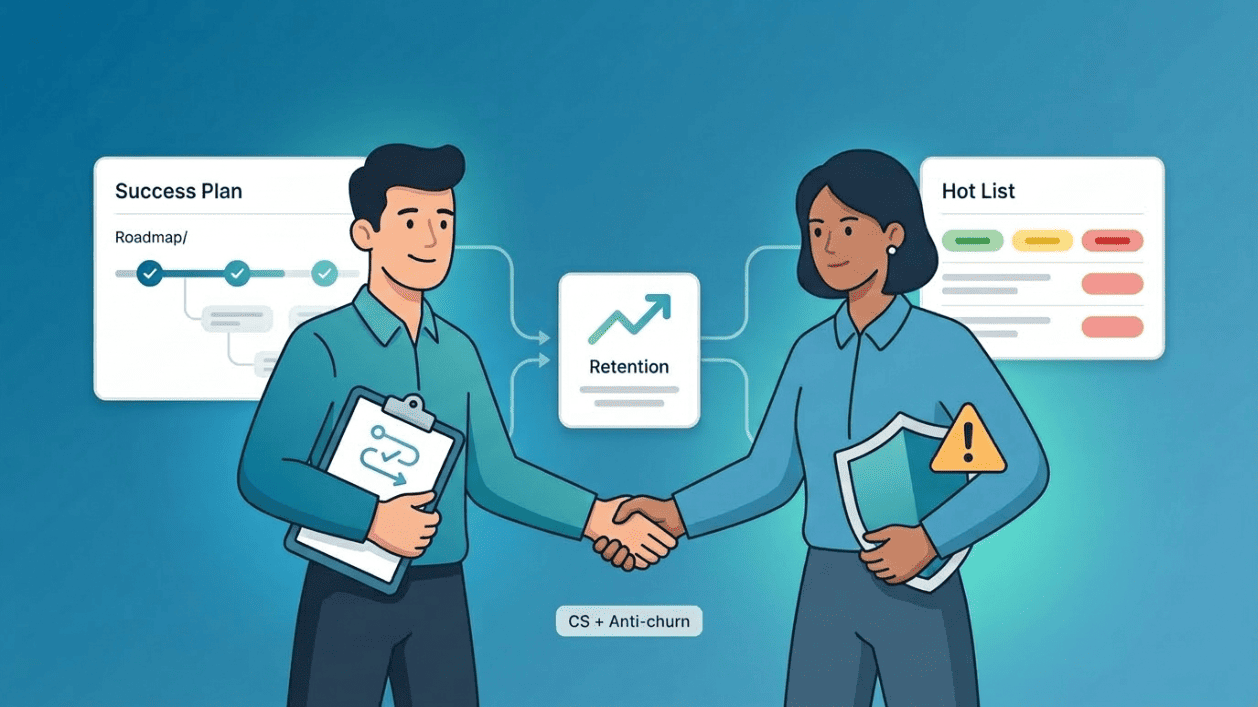
Combine an anti-churn tool with human-led Customer success for high-value accounts
The best approach for growing SaaS companies is a hybrid one: using anti-churn automation for 80% of the customer base (SMB accounts with low MRR) and having human CS representatives handle the remaining 20% of strategic accounts (high MRR, expansion potential).
ChurnGuard, for example, can automatically prioritize churn alerts based on MRR, allowing your CSM to focus their time where the financial impact is greatest, rather than manually reviewing every alert.
Measuring the impact of your anti-churn tool (key metrics to track)
To determine whether your investment in a customer retention tool is worthwhile, track these metrics:
- Retention rate: Percentage of at-risk customers successfully retained as a result of the actions taken
- Preserved MRR: amount of recurring revenue saved each month
- Average detection time: How many days before termination was the issue reported?
- Direct ROI: (MRR saved × 12) / annual cost of the tool
A good anti-churn tool should deliver a minimum ROI of 3x to 5x in the first year. If it doesn’t, either the tool isn’t the right fit, or your churn has underlying structural causes that the tool alone cannot resolve.
Conclusion
The anti-churn tools market in 2026 is divided into two categories: comprehensive Customer Success platforms (Gainsight, ChurnZero, Totango) designed for large CS teams, and specialized anti-churn tools (ChurnGuard, ProfitWell) designed to automate retention without hiring additional staff.
For most French SaaS companies in the early-stage and growth phases, enterprise customer success platforms are oversized, too expensive, and take too long to deploy. A proactive anti-churn tool like ChurnGuard, which detects signals in real time and recommends immediate actions, delivers a much higher ROI for a fraction of the cost.
Your choice of tool depends on three factors: your customer segment (SMB vs. enterprise), your primary type of churn (involuntary vs. voluntary), and whether or not you have a customer success team. To further develop your retention strategy, check out our comprehensive guide to SaaS churn and our 5 key strategies for reducing churn.